
This is general information, not legal advice. The copyright section below describes how US law generally works, and your situation may differ. For anything significant, pay a lawyer to look at it.
Short answer: the warning signs are mostly about effort. Someone who will not answer specific questions, cannot show verifiable work, or wants paying in full before anything exists is telling you how the project will go.
But spotting red flags is only half the job, and it is the half everyone writes about. The other half is what you put in place after you have found someone good, which is where most freelance relationships actually come unstuck.
That includes one thing that surprises nearly everybody: paying a freelancer does not automatically mean you own what they make.
Nine red flags
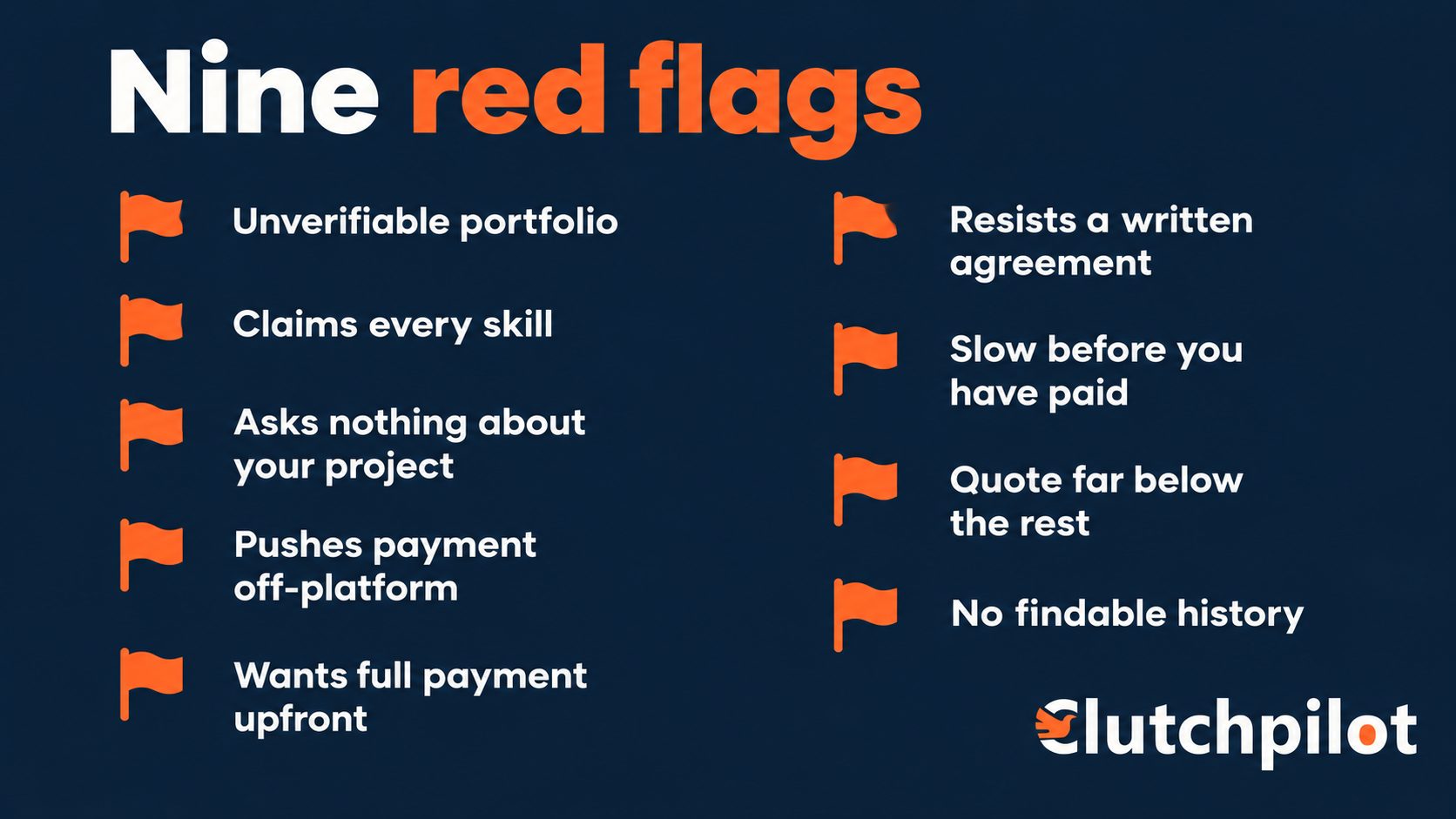
1. A portfolio you cannot verify independently
Screenshots prove nothing. Anyone can save an image.
Ask which pieces are specifically theirs, what their role was on each, and whether the work exists somewhere you can look at it. A designer who contributed one screen to a large app and a designer who built the whole thing can show you the same screenshot.
The honest exception: NDAs are real. Plenty of good freelancers genuinely cannot show their strongest work, particularly in agency and enterprise contexts. What matters is whether they can describe their contribution precisely and point to something verifiable, not whether every piece is public.
2. They say they can do everything
Full-stack developer, brand strategist, copywriter, videographer and SEO specialist is a list of five careers.
Specialists who have genuinely broadened usually describe it with hierarchy: what they are excellent at, what they are competent at, and what they subcontract. Someone who presents all five as equal strengths is describing an ambition rather than a skill set.
3. They do not ask about your project
The strongest single signal in this list.
A freelancer who quotes without asking what success looks like, who the audience is, what already exists, or what you have tried before is pricing a generic job. They will deliver a generic job.
Good ones ask questions that are slightly uncomfortable, because the uncomfortable questions are the ones that change the brief.
4. Pressure to move payment off-platform
If you found them on a marketplace and they want to be paid by bank transfer or a payment app instead, understand what that removes.
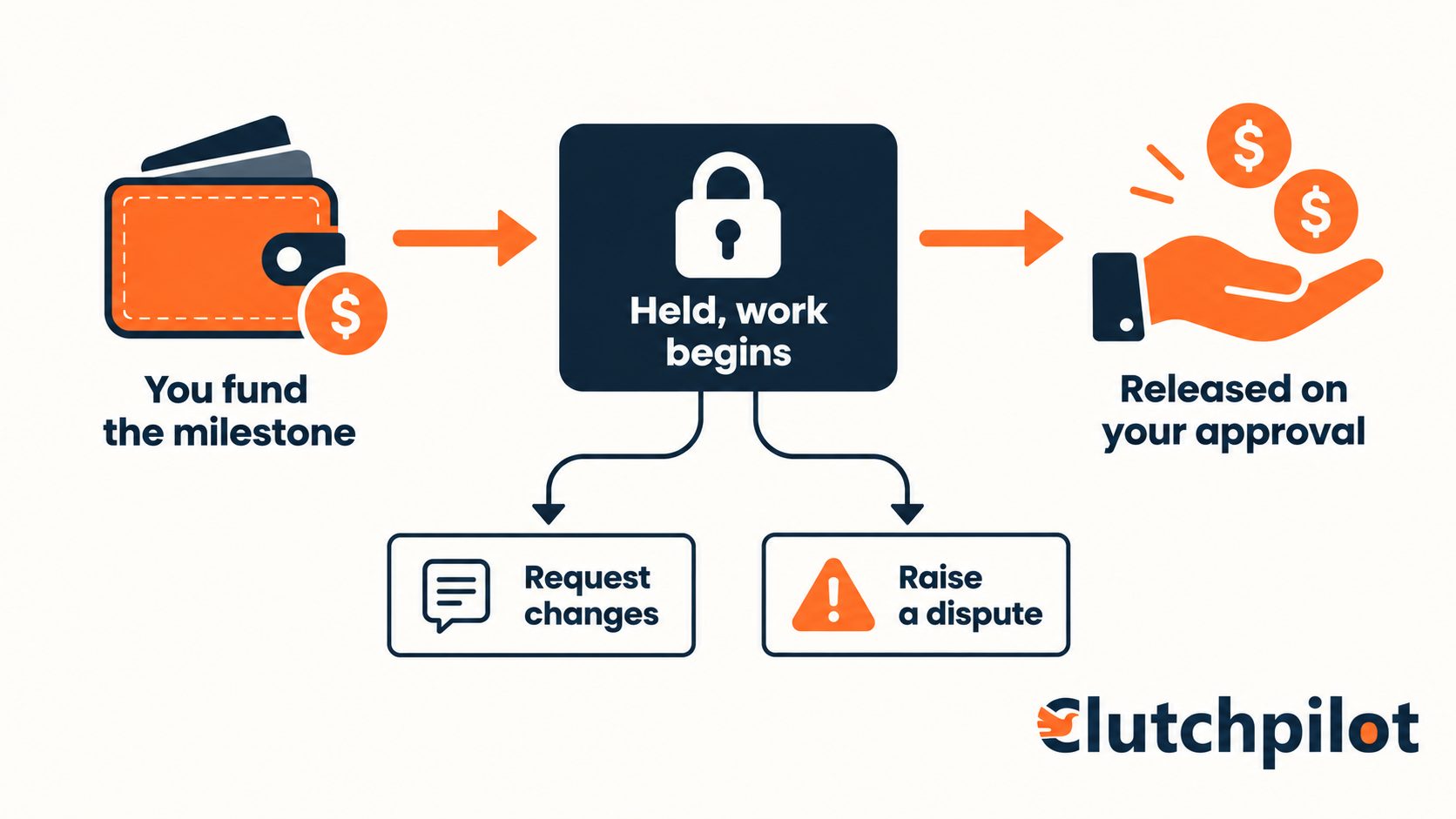
Platform escrow holds your money and releases it on agreed milestones, with a dispute process if the work does not arrive. Moving off-platform removes all of that and leaves you with a transfer you cannot reverse.
There are legitimate reasons freelancers dislike platform fees. There is no legitimate reason to ask a brand new client to drop the protections before any work has been delivered.
5. Full payment upfront
A deposit is normal. The whole fee before anything exists is not.
The distinction worth drawing: a deposit covers their commitment and any costs they incur before delivery. Full payment transfers all of the risk to you at the point where you know least about them.
6. Resistance to a written agreement
Including the softer version, which is far more common: "I'll send something over" followed by nothing, and a project that starts anyway.
A one-page agreement is not bureaucracy. It is the only record of what you both thought you agreed, and the people most reluctant to produce one are rarely the people you want handling an ambiguity.
7. Communication is already slow before you have paid
This is the pre-sale period, when their effort is at its highest. Two days for a reply now is not two days once they have your deposit and three other clients.
The honest exception: good freelancers are often busy, and a slow but substantive reply beats an instant but empty one. The pattern to watch is unpredictability rather than speed.
8. A quote far below everyone else
Same logic as any other trade. Very low quotes usually mean a narrower job than you described, less experience than you assumed, or a plan to make up the difference in revisions and extras.
Ask what is excluded rather than assuming you found value.
9. No verifiable professional history anywhere
No reviews, no profile that matches the claimed background, no findable work, and a portfolio that only exists as attachments.
The honest exception, and it matters: every freelancer was new once, and genuinely new people deserve work. The answer is not to refuse them, it is the paid test task described below, which lets someone prove themselves on a small piece before you commit to a large one.
Four things people mistake for red flags
Worth saying, because treating these as warnings costs you good people.
No registered company. Most freelancers operate as sole proprietors and many have no company, no VAT number and no trading name. That is a completely normal way to freelance. What matters is whether they will sign an agreement and invoice you properly, not whether they have incorporated.
A quote higher than you expected. A high quote is usually a scoped quote. Someone who has thought about the hidden parts of your project will price them, and the cheaper person who has not thought about them will find them later and ask you for more money then.
They turn work down or push the deadline out. This is the behaviour of someone with a full calendar who is telling you the truth about it. The alternative is somebody who agrees to everything and then misses it.
They disclose that they subcontract part of it. Disclosed subcontracting is fine and often better, since a designer who hands the build to a developer they trust will beat a designer who attempts the build themselves. The red flag is undisclosed subcontracting, which you tend to discover when the writing style or code quality changes halfway through. Ask directly who will be doing which parts, and ask it early enough that an honest answer is easy to give.
How to hire one safely
Spotting red flags narrows the field. These four things protect you once you have chosen somebody, and almost nobody writes about them.
Verify the portfolio properly
Three questions do most of the work:
Which parts of this were yours? Specific, and surprisingly revealing.
Can I see it live? A URL, an app store listing, a published article. If it is not public, why not, and can they describe the constraint?
Can I speak to that client? The request itself is informative even if you never make the call.
For anything visual, run a reverse image search on a few portfolio pieces. It takes a minute and it occasionally returns somebody else's work on somebody else's site, which is the clearest answer you will ever get.
Use escrow where it exists, milestones where it does not
On a marketplace, use the platform's fixed-price contracts. Upwork's own description of how it protects payments sets out the shape of it: you fund each milestone before work on it begins, the work is submitted for your approval before the money is released, you can request changes or a refund instead of approving, and either side can raise a dispute. Note the balance in that arrangement. It also protects the freelancer, because funds release automatically if you neither approve the work nor ask for changes within the stated window. Other platforms work similarly with their own variations, so read the specific terms rather than assuming.
That mechanism answers the "should I pay upfront" question better than any rule of thumb, because the money is neither in your account nor theirs while the work happens.
Working directly, build the same shape yourself:
- A deposit proportionate to the work, not the whole fee
- Payments tied to defined deliverables, not dates on a calendar
- Final payment on acceptance, not on submission
The deliverables point matters more than it sounds. "Payment on the 15th" can leave you fully paid for work that has not happened. "Payment on delivery of the approved homepage design" cannot.
Get ownership in writing before work starts
Here is the part that catches people out, and it catches out businesses far larger than you would expect.
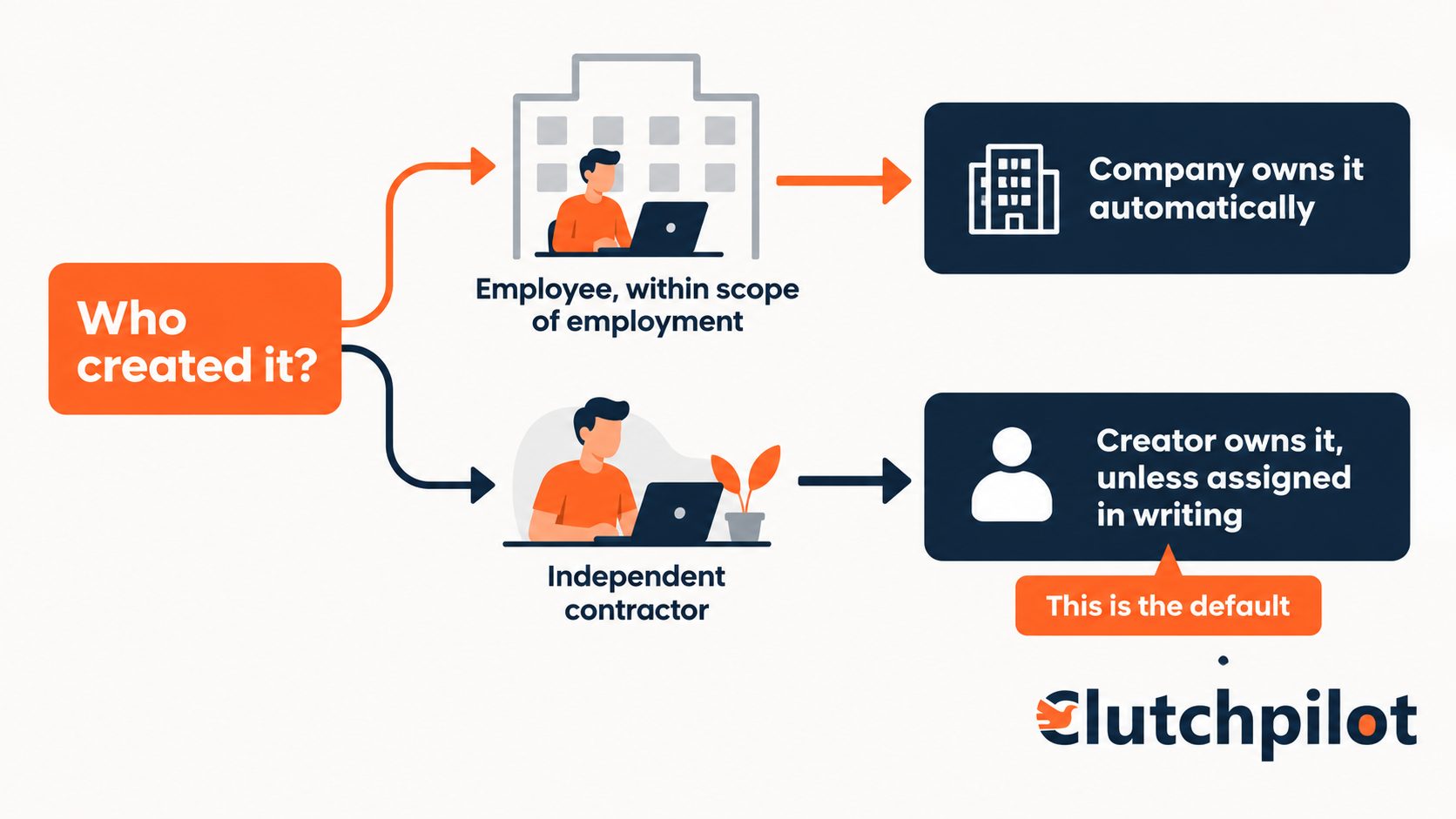
In the US, paying for creative work does not automatically make you the owner of the copyright. The default is that the person who created it owns it.
Work made for hire, which does transfer ownership automatically, applies to work created by employees within the scope of their employment. For work commissioned from an independent contractor it applies only when both conditions are met: the parties expressly agree in a written instrument signed by them that it is a work made for hire, and the work falls into one of nine specific statutory categories.
The US Copyright Office sets out those nine categories as a contribution to a collective work, part of a motion picture or other audiovisual work, a translation, a supplementary work, a compilation, instructional text, a test, answer material for a test, or an atlas. If any of the required elements is missing, the work is not a work made for hire.
Look at that list and then think about what you are commissioning. A logo, a website design, a set of photographs or a standalone illustration does not sit comfortably in any of those nine categories. A retroactive work-for-hire designation does not fix it afterwards either, so the mechanics of how this applies to commissioned work are worth understanding before you sign anything.
What you actually need is a written copyright assignment, signed by the freelancer, ideally in place before work begins.
What it should cover:
- The deliverables themselves
- Source files, not just the exported versions
- What happens to drafts, rejected concepts and working files
- Whether the freelancer can show the work in their own portfolio, which most will want and which is usually reasonable to grant
The practical consequence of skipping this is not theoretical. Without an assignment you may hold a licence to use the work rather than ownership of it, which becomes a problem the first time you want to modify it substantially, register a trademark, or sell the business and transfer the brand assets with it.
A copyright assignment is a contract clause, so it belongs in the written agreement rather than an email. Our guide to reading a contract before signing ranks the clauses that matter by what they can cost you, and ownership sits near the top for exactly this reason.
Start with a paid test task
The most useful practice in this article and the one almost nobody mentions.
Before committing to a large project, hire the person for a small paid piece of it. A single page rather than the site. One article rather than the content programme. A concept round rather than the full identity.
You learn four things no amount of vetting tells you: whether they hit a deadline, whether their communication works for you, whether the quality matches the portfolio, and whether you enjoy dealing with them.
It costs a fraction of the project and it is also the fair answer to red flag 9. A genuinely new freelancer with no reviews cannot prove themselves any other way, and a test task lets good new people in rather than locking them out.
Agree revisions upfront
How many rounds are included. What counts as a revision versus a new brief. What additional rounds cost.
This single paragraph in an agreement prevents more freelance disputes than any other, because "a few tweaks" and "a redesign" look identical from one side and nothing alike from the other.
The distinction that does the work: a revision changes how something was executed, and a new brief changes what was asked for. Adjusting the spacing and the headline on a page you approved the structure of is a revision. Deciding the page needs a different structure is a new brief. Neither of those is unreasonable to want, and both get much easier to discuss when the line was drawn before anyone was annoyed.
Two rounds is a common default for design work and is usually enough when the brief was clear at the start. If you suspect your own brief is vague, say so and buy a third round rather than discovering the problem at round two.
What a freelance agreement should cover
A one-page document covering these is enough for most projects:
- Scope and specific deliverables
- File formats and what gets handed over
- Deadlines, including what you owe them and when
- Payment schedule tied to deliverables
- Number of revision rounds and the cost of more
- Copyright assignment
- Confidentiality, where relevant
- What happens if either side wants out
An email chain is not a contract. It is a record of a conversation in which two people may have understood different things, and it is spectacularly bad at settling a disagreement eight weeks later.
The three that matter most
Verify the portfolio independently, because that is the claim everything else rests on.
Structure payments around delivered work, because that is what keeps your money safe.
Get ownership in writing before anybody starts, because that is the one you cannot fix afterwards.
Comments (0)