

This is general information, not legal advice. If the contract is for significant money, commits you long term, or contains anything you cannot make sense of after a careful read, pay someone qualified to look at it.
Short answer: read for ten specific clauses in order of what they can cost you, not from top to bottom. The clauses that cause the most damage are rarely the ones that look important, and one of the worst sits near the end under a heading most people skip.
Before any of that, three things take two minutes and matter more than anything in the document.
Do these three things first

These apply to every contract regardless of what it says.
Never sign a contract with blank spaces
Wisconsin's consumer protection guidance on contracts is direct about why: once you have signed, it is extremely difficult to prove the space was empty at the time.
If a figure, date or specification is not settled yet, do not leave it open. Strike the line through, or write in what was actually agreed, or write "to be confirmed in writing" and initial it. A blank line in a signed contract is a space somebody else gets to fill in later.
Cross out anything you do not accept
This is the most useful thing a consumer can do with a contract and almost nobody knows they can.
If a clause does not apply to your situation, or you are not willing to agree to it, strike it through, initial the change, and have the other party initial it too. Wisconsin's guidance is explicit that if you sign with those clauses still in place, you are responsible for them.
One honest caveat. The other side can refuse. A contract binds only when both parties agree, so striking a clause is a proposal rather than a power, and they may come back and say no. That is fine and it is also informative. A business that will not discuss a single clause in its own document is telling you how the next three months will go.
Get every verbal promise into the written document
Whatever was said on the driveway, in the showroom or on the phone, it needs to appear in the contract. Wisconsin's guidance notes that in a dispute the written contract prevails.
Clause 2 below explains exactly why this matters more than most people realise.
The 10 clauses, ranked by what they cost you
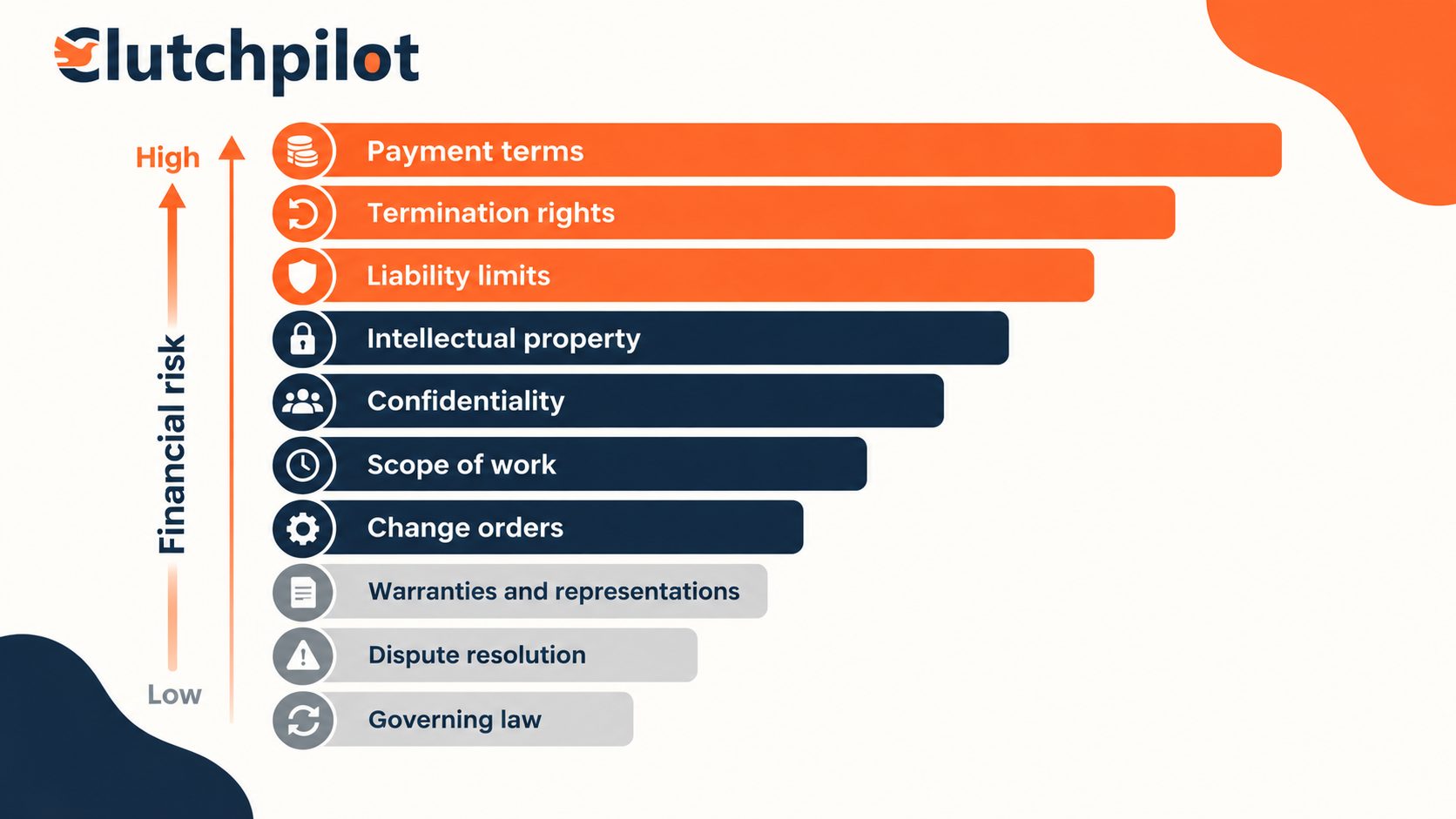
Every competitor guide lists contract sections in the order they appear in the document. That is a table of contents. This is the order they can hurt you in.
1. Scope of work and exclusions
What it does: defines the job you are actually buying.
The single biggest source of service contract disputes, and the one most often left vague because both parties think they already agree.
What good looks like: the work itemised line by line, materials specified by brand, model and quantity rather than "or similar", allowances stated with their unit rates, and an explicit list of what is excluded.
If it is wrong: do not sign until the scope matches what you priced. If you compared several quotes, the contract scope should match the scope you normalised. Our guide to comparing contractor quotes covers that process, and a mismatch between the quote you accepted and the contract you signed is exactly how people end up paying for a job they never priced.
2. The integration clause
What it does: cancels every promise that is not written in the document.
This is the sleeper, and the reason it ranks second. It usually appears near the end, under a heading like "Entire Agreement" or "Integration", and reads something like "this agreement constitutes the entire agreement between the parties and supersedes all prior representations."
In plain terms: anything said to you before signing has no legal effect. Wisconsin's guidance flags this directly, noting that some contracts state representations made outside the written agreement are not recognised.
Every "but they promised me they would" dispute founders on this clause.
What to do: before you sign, go back through your notes and your emails. Every assurance that mattered to your decision, the start date, the brand of fixtures, the fact they would move the furniture, needs to be in the contract. If it is not written down, it does not exist.
3. Payment schedule and deposit
What it does: decides how much of your money is exposed and when.
What good looks like: a deposit proportionate to the materials they have to buy, progress payments tied to completed and verifiable milestones rather than calendar dates, and a final payment withheld until the work is finished and you are satisfied with it.
The FTC's guidance on home improvement notes that many states limit how much a contractor can ask for as a down payment, so check your own state's position before agreeing a figure.
If it is wrong: payments tied to dates rather than progress can leave you fully paid on work that has not happened.
4. Change orders and variations
What it does: governs how the price changes once work has started, which it almost always does.
What good looks like: any variation written, priced and signed by both parties before the work is carried out. No exceptions for small items, because small items are how budgets move.
If it is wrong: watch for language allowing the provider to vary the price unilaterally, or silence on the subject, which amounts to the same thing. "We will sort it out at the end" is not a change order process.
5. Termination and cancellation
What it does: sets what it costs to get out, for both of you.
What good looks like: clear terms on each side, a defined notice period, and a stated basis for what you owe if you cancel part way through.
Wisconsin's guidance notes that cancelling usually means losing your deposit, and your losses could be larger depending on the contract's minimum requirements. There are also separate cancellation rights in some circumstances, including sales made at your home, which vary by state.
If it is wrong: a contract with no cancellation terms at all is not simpler, it is less predictable.
6. Automatic renewal
What it does: rolls the contract over unless you cancel in a specific window.
Critical for anything ongoing: cleaning, landscaping, maintenance, monitoring, pest control, marketing retainers.
What good looks like: a clearly stated notice period, measured from a date you can identify, with a method of cancelling that does not require a phone call at a specific hour.
If it is wrong: the common trap is a short window that opens and closes months before renewal. Put the date in your calendar the day you sign, not the week it renews. Several states regulate automatic renewal terms, so check your own.
7. Warranty and its exclusions
What it does: sets what gets fixed free, for how long, and under what conditions.
The exclusions matter more than the period. A twelve month warranty excluding anything caused by "normal wear", "settling" or "improper use" can be considerably narrower than it sounds.
Wisconsin's guidance includes a warning worth repeating: be wary of guarantees, because unless they are specific they may be worthless.
What good looks like: separate terms for labour and materials, a named period for each, exclusions listed explicitly, and a stated process for making a claim.
8. Liability limits and indemnification
What it does: decides who pays when something goes wrong, and caps how much.
Two things to look for. A limitation of liability clause caps what the provider owes you, sometimes at the contract value and occasionally far below it. An indemnification clause can make you responsible for certain costs the provider incurs.
What good looks like: a liability cap that bears some relationship to the damage that could realistically occur. A cap of a few hundred dollars on work that could flood a house is not meaningful protection.
If it is wrong: this is one of the clauses genuinely worth a lawyer's eye on a large job.
9. Dispute resolution and arbitration
What it does: decides where and how a disagreement gets settled.
A binding arbitration clause means you give up the right to take the matter to court, and in many cases that includes small claims court. Arbitration can be quicker, and it can also be costly and weighted toward the party that writes the contracts.
Wisconsin's guidance lists four to look for specifically: the arbitration clause, which specifies how disputes are handled, enforcement clauses, legal fees clauses stating which fees can be recovered on a breach, and waiver clauses, which may waive your rights.
What to do: read the legal fees clause alongside the arbitration clause. A one-way fee provision, where you pay their costs but not the reverse, changes the economics of ever complaining.
10. Governing law and venue
What it does: sets which state's law applies and where a claim has to be brought.
Mostly irrelevant with a local provider and very relevant with an out-of-state company. A venue clause requiring you to sue in a state two thousand miles away can make a four thousand dollar dispute uneconomic to pursue, which is sometimes the point.
What good looks like: your own state, or at least somewhere you could realistically get to.
Electronic signatures count

Worth saying plainly because people treat clicking differently from signing, and the law does not.
An electronic signature binds you exactly as a pen does. Wisconsin's guidance makes the same point and adds a practical one: if the document is hard to read on the screen, ask for a copy you can read properly before agreeing.
Two additions. Read it on something larger than a phone, because scrolling through a thirty page PDF on a handset is how people miss clause 2. And save your own copy of the executed contract rather than relying on a platform link in an email, since those expire.
Wisconsin also advises getting a copy of the signed contract and keeping it, for reference or for any future complaint. That is worth doing whether you signed on paper or on a screen.
Red flags
Pressure to sign immediately. A contract that has to be signed today is a sales tactic.
Blank spaces anywhere in the document.
A contract that contradicts the written quote. Whichever document you sign is the one that counts.
Refusal to add a verbal promise in writing. If it was true enough to say, it is true enough to write.
No cancellation terms at all.
Vague guarantees. "Fully guaranteed" with no period, no scope and no claims process.
A document that only ever arrives as an unreadable phone-screen PDF.
One counterweight. A long contract is not a bad sign. A detailed one usually means someone thought carefully about the edges of the job. The friendly one-page agreement is frequently the one with nothing in it when a dispute arrives.
When it is worth paying a lawyer
"Consult an attorney" on every contract is advice nobody follows, so here is where the line realistically sits.
Worth paying for a review when the value is large relative to your finances, when the contract commits you for an extended period rather than a single job, when it contains indemnification or an unusual allocation of liability, or when something in it remains genuinely unclear after you have read it carefully twice.
Some states also require a written contract above a threshold for certain work. The Illinois Attorney General's home repair guidance, for instance, says to get a written contract for any home repair or remodelling job over $1,000, and that contractors must provide a consumer rights pamphlet before a contract over that amount. Thresholds and requirements vary by state, so check your own rather than assuming.
Wisconsin's guidance puts the general principle simply: if you do not understand any part of the contract, get advice before signing.
Before you sign

No blank spaces. Cross out what you do not accept, and get it initialled. Check that every promise that mattered to your decision is written in the document.
Then read the ten clauses above, starting with scope and the integration clause, because those two decide most of what follows.
Comments (0)