

Short answer: the cheapest quote is usually the one with the least realistic allowances, and you will not find that out until you are standing in a tile shop three weeks into the job.
Comparing quotes properly takes four steps. Confirm all three priced the same scope. Adjust every allowance to what you will actually buy. Add back whatever each quote excluded. Then, and only then, compare the totals.
There is a worked example below showing how that process changed which of three bids was genuinely cheapest, and a free comparison sheet you can use on your own quotes.
Why quotes for the same job vary so much
The spread is wider than most people expect. Kiplinger, citing Consumers' Checkbook data, reported estimates for one job ranging from $113,000 to $205,000, and for another from $26,000 to $61,000.
Your first instinct on seeing a spread like that is that somebody is trying it on. Usually nobody is.
A gap that wide almost always means the three contractors priced different jobs. Different assumptions about materials, different views on what was included, different interpretations of a scope you described in a twenty-minute conversation. The Illinois Attorney General's home repair guidance puts the requirement precisely: get at least three written estimates for the same work, and do not automatically choose the lowest bid.
Those three words, for the same work, are where most comparisons fall apart.
Why the cheapest quote is usually not the cheapest
Three things make headline numbers misleading, and all three are ordinary rather than sinister.
Allowances are set at different levels. When you have not chosen your tile yet, the contractor has to guess. Guess low and the total looks better.
Exclusions differ. One quote prices demolition and disposal, another assumes you are handling it. Nothing dishonest has happened, and the two numbers are not comparable.
The scope was never identical. You described the job three times to three people. They heard three slightly different jobs.
None of this requires bad faith from anyone. It does mean the quote you accept is not the price you pay, unless you normalise first.
Allowances, and why they decide everything

This is the part most guides skip, and it is the single biggest reason quote comparison goes wrong.
What an allowance actually is
An allowance is a placeholder budget for something nobody has chosen yet.
Tile, flooring, countertops, cabinets, fixtures, lighting, door hardware. The contractor cannot price what you have not picked, so they insert a figure and carry on. If your actual choice costs more than the allowance, you pay the difference. If it costs less, you get a credit, in theory.
The practical effect: a quote with low allowances looks cheaper and is not. It is the same job with more optimistic placeholders.
How to find them
Sometimes they are labelled clearly. Sometimes they sit inside a line item with no indication. Occasionally they are invisible, which is the worst case because you cannot adjust for what you cannot see.
Ask directly: "Which line items are allowances, and what unit rate did you assume for each?"
A good contractor answers that from their own notes. A quote for a job involving finishes that contains no allowances at all either has unusually complete specifications attached, or has buried them.
The normalising step
Decide what you actually want, or at least a realistic version of it, then apply the same figure across all three quotes.
If you intend to buy tile at $12 a square foot, every quote gets costed at $12 a square foot regardless of what each contractor assumed. The arithmetic is straightforward. The discipline is doing it before you choose rather than after.
Exclusions, the second thing that moves the number

Everything an allowance does to the materials side, exclusions do to the labour and logistics side.
Commonly excluded, and commonly assumed to be included:
- Demolition, disposal and skip hire
- Permit and inspection fees
- Making good after the work
- Painting and decorating
- Moving or protecting furniture
- Temporary facilities and site protection
- Anything described as "supplied by homeowner"
The method is the same as for allowances. List every exclusion across all three quotes, then add each missing item back to whichever quotes left it out, priced consistently.
One honest point worth making. A quote with a long exclusions list is not necessarily a worse quote. It is often the most carefully written one, because the contractor has thought about the edges of the job and told you where they are. The problem is not the exclusions themselves, it is comparing that quote against one that stayed silent and let you assume.
A worked example
Every number in this section is invented. It is a fictional job built to demonstrate the method, not a pricing guide. Do not read these figures as what a bathroom costs, because they are not market rates and they are not based on real quotes.
The job: a 120 square foot bathroom remodel. Three quotes.
Stage 1: the headline numbers
| Contractor A | Contractor B | Contractor C | |
|---|---|---|---|
| Quoted total | $18,400 | $22,100 | $24,800 |
A looks $6,400 cheaper than C, and $3,700 cheaper than B. On these numbers alone, most people stop reading.
Stage 2: adjust the allowances
The homeowner wants tile at $12 a square foot, a vanity around $900, and fixtures around $600. Here is what each contractor assumed.
| Allowance | What you want | A assumed | B assumed | C assumed |
|---|---|---|---|---|
| Tile (per sq ft) | $12 | $4 | $12 | $15 |
| Vanity | $900 | $400 | $900 | $1,200 |
| Fixtures | $600 | $200 | $600 | $800 |
Adjusting each quote to the same specification:
| A | B | C | |
|---|---|---|---|
| Tile (120 sq ft) | +$960 | $0 | −$360 |
| Vanity | +$500 | $0 | −$300 |
| Fixtures | +$400 | $0 | −$200 |
| Allowance adjustment | +$1,860 | $0 | −$860 |
| Running total | $20,260 | $22,100 | $23,940 |
A has closed most of the gap and nobody has done anything wrong. A simply assumed cheaper tile.
Stage 3: add back the exclusions
| Excluded item | A | B | C |
|---|---|---|---|
| Demolition and disposal | Excluded (+$1,800) | Included | Included |
| Permit fees | Excluded (+$450) | Included | Included |
| Exclusion add-back | +$2,250 | $0 | $0 |
Stage 4: the normalised totals
| Contractor A | Contractor B | Contractor C | |
|---|---|---|---|
| Original quote | $18,400 | $22,100 | $24,800 |
| Allowance adjustment | +$1,860 | $0 | −$860 |
| Exclusions added back | +$2,250 | $0 | $0 |
| Normalised total | $22,510 | $22,100 | $23,940 |
The ranking changed.
A started out looking $3,700 cheaper than B. Normalised, A is $410 more expensive. The apparent $6,400 spread across the three quotes has collapsed to $1,840.
Nobody lied. A assumed cheaper finishes and told you, in writing, that demolition and permits were not included. All of that was visible on the quote. It just was not visible in the total.
The comparison sheet
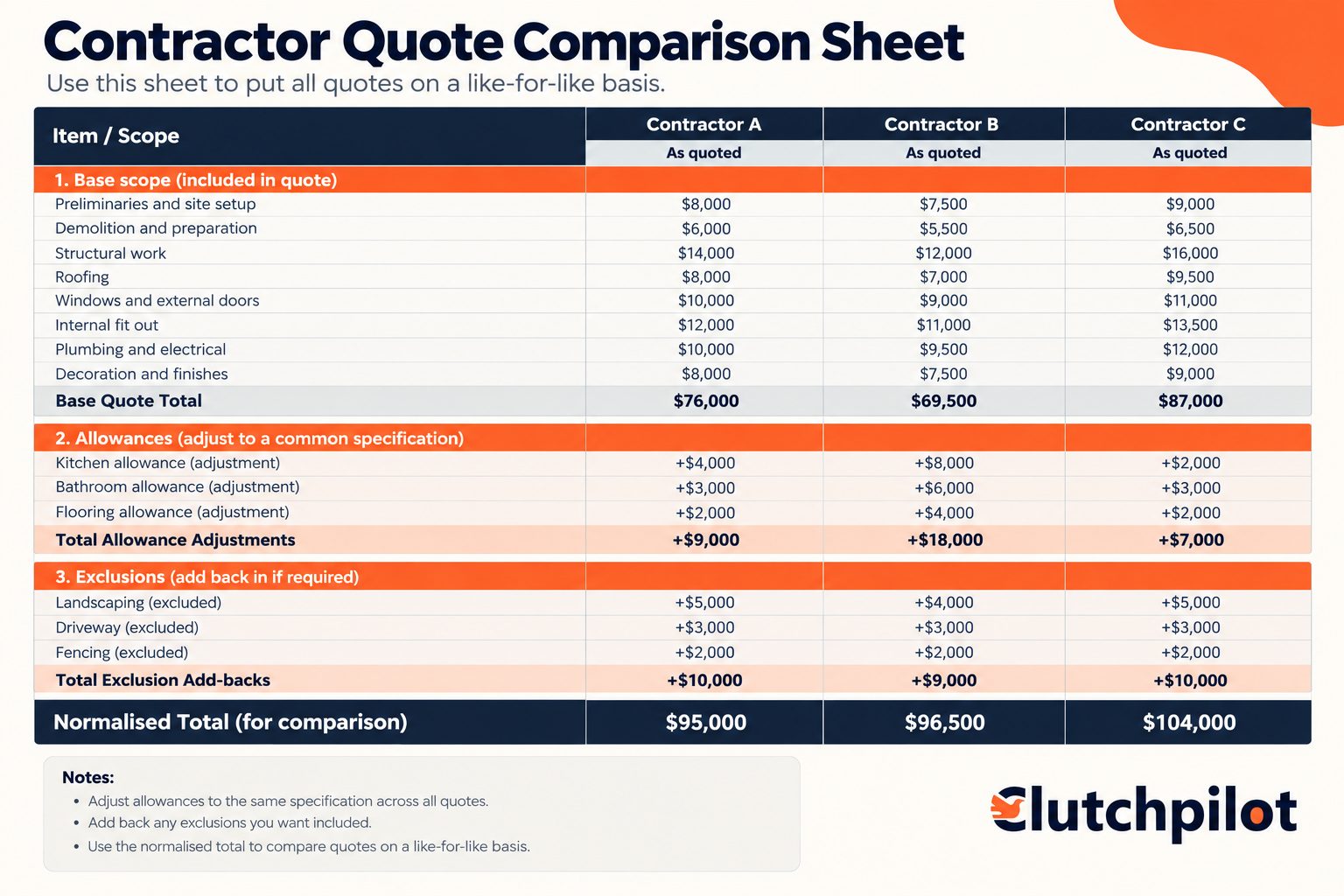
Doing this by hand on three quotes is tedious and easy to get wrong, so there is a sheet for it.
It has a row for every scope line item and a column for each contractor, with separate sections for allowance adjustments and exclusion add-backs, and a normalised total that calculates at the foot. Fill in the three quoted figures, enter what each contractor assumed for the allowances, tick off what each excluded, and the real comparison appears.
Available as a spreadsheet and as a printable one-pager if you would rather work on paper at the kitchen table.
What to weigh once the numbers are level
When the normalised totals land within roughly ten percent of each other, price has stopped being the deciding factor. At that point you are choosing between three broadly similar prices and three very different businesses.
What actually decides it:
The quality of the quote itself. The contractor who itemised properly, named their allowances and listed their exclusions has told you how they run a job. That is a preview.
How they handled your questions. Specifically, whether they volunteered the inconvenient parts.
Timeline realism. The shortest timeline is rarely the most accurate one.
Who is actually doing the work, and how many other jobs they are running at the same time.
References for recent, similar work. Not three years ago, and not a job a quarter of the size.
Our guide to questions to ask a contractor before you hire them covers what each of those answers should sound like, which is the real tiebreaker once the arithmetic stops helping.
Red flags when comparing
A quote far below the others with no explanation. Ask what is excluded before assuming you found a bargain.
No written exclusions at all. Either exceptionally thorough specification, or nobody thought about it.
Allowances conspicuously below the other two. The clearest single signal in the whole exercise.
A total with no breakdown. The FTC's guidance is that a written estimate should detail the work, the materials, the completion date and the price. A single figure gives you nothing to compare.
Pressure to accept before the other quotes arrive. A price that expires tonight is a sales tactic.
A number that never moves. This one is the counterintuitive case. A contractor who revises their figure upward after you clarify the scope is behaving correctly, not switching the bait. The ones to watch are those whose total stays identical no matter what you tell them, because it means the number was never connected to the work.
Three steps, in order

Same scope. Same allowances. Same exclusions.
Only after all three are true does the total mean anything, and by then the numbers are usually much closer together than they first appeared. Which is the point: the comparison that matters is rarely the one printed on the front page of the quote.
Comments (0)