
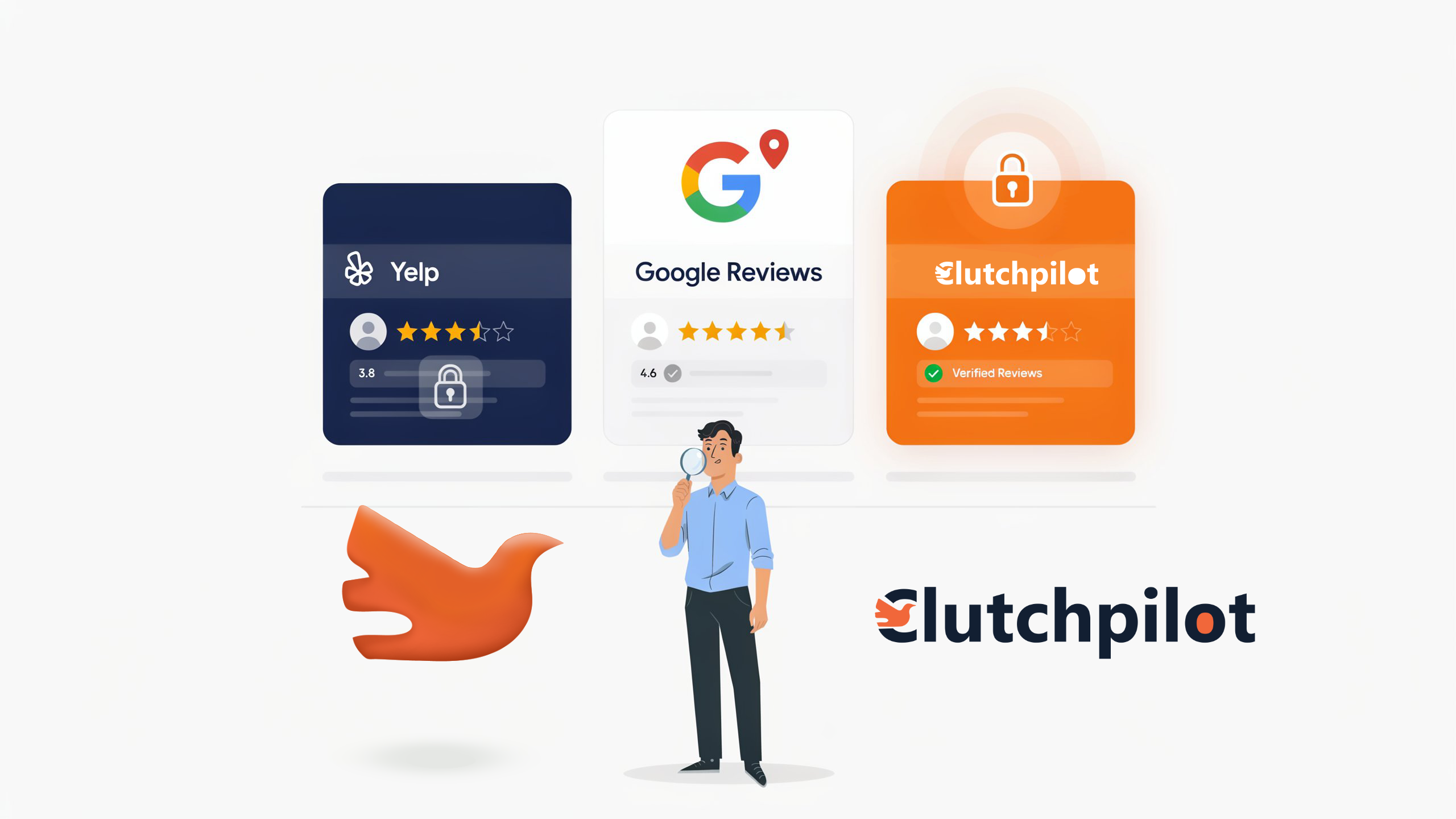
Three Platforms, One Question That Actually Matters
Somewhere right now, a small business owner is staring at their phone wondering why their reviews are not showing up on Yelp, why their Google listing is buried behind competitors with hundreds of reviews, and whether there is another option that does not require a monthly advertising budget just to be seen.
This is the comparison they need.
Yelp and Google Reviews are the two most recognized names in local business discovery. But recognition does not automatically mean the best fit for every business. There is a third platform in this comparison, Clutchpilot, that most local business owners have not considered yet. And for a specific type of business, it may be the most practical option of the three.
This article compares all three platforms across the criteria that actually matter
cost, review verification, category depth, paywall restrictions, and visibility for local businesses. By the end, you will know exactly which platform or combination of platforms, makes sense for your business.
Why This Comparison Matters More Than Ever
Online reviews are not a nice-to-have anymore. They are a deciding factor and research consistently shows that approximately 97 percent of consumers read reviews before reaching out to a local business. The average buyer checks up to six different review sources before making a decision. Review signals account for approximately 16 percent of what determines a business's position in Google's local search results.
Choosing the wrong platform wastes time and money. Choosing no platform at all is even more costly. This guide helps you choose with clear information rather than assumption.
A Quick Comparison at a Glance
Before diving into the details, here is how the three platforms compare across the criteria that matter most to a local business owner. The sections following this table explain each row in full.
Criteria | Yelp | Google Reviews | Clutchpilot |
|---|---|---|---|
| Listing Cost | Free basic or Paid Ads | Free | 100% Free |
| Review Verification | Algorithm Filter (aggressive) | Google account required | Verified reviews |
| Paywall Features | Yes, many premium features | Partial | None (always free) |
| Category Depth | Limited (approx. 50 categories) | Broad but generic | Free to list, no contract |
| Local SEO Impact | Low direct impact | Very High (local ranking) | Growing organic reach |
| Business Control | Limited on free tier | Full via Google Business | Full (always) |
| Review Requests Allowed | No, it violates ToS | Yes | Yes |
| Ad Options | CPC ($150 to $10,000 a month) | Google Ads (separate) | None needed (free) |
| Filter or Suppress Reviews | Yes, it's algorithmic | Rarely | No suppression |
Every row in this table is discussed in detail below. If one comparison point is your top concern, use the headings to jump directly to that section.
Yelp The Platform That Started the Local Review Era
Yelp started back in 2004. It was the first platform to make local business reviews a big part of daily life in the United States. Now it has a collection of approximately 330 million cumulative reviews. About 74 million unique visitors head to Yelp every month. For people Yelp is just the first name that comes to mind when they want to check a business before they go.
The popular parts of Yelp are restaurants, nightlife, beauty and wellness and home services. In US cities like San Francisco, New York and Los Angeles Yelp still gets a lot of attention in those specific areas. If you own a restaurant in Manhattan or a hair salon in Chicago having a Yelp presence is truly helpful, for your business.
The free listing tier allows businesses to claim their profile, add photos, respond to reviews, and appear in Yelp search results. That is where the free access largely ends.
What Yelp Does Well
Yelp's consumer audience is loyal and specific. The people who use Yelp are loyal and specific. Most people who use Yelp regularly check the platform before they decide on food, beauty or home service categories. I have noticed that the reviews are often very detailed and descriptive. This gives buyers useful information. The mobile app is polished and widely used in urban markets. For businesses in Yelp's core categories operating in major cities, the platform still delivers real consumer traffic.
Yelp also has a strong search engine presence of its own. Yelp pages frequently appear in Google's organic results when someone searches a business name, adding a second page of visibility beyond the Yelp platform itself.
Where Yelp Falls Short for Small Businesses
The review filter is Yelp's most documented frustration for business owners. Yelp uses a proprietary algorithm to choose which reviews are shown to visitors and which are placed in a not recommended section that most people never see. Reviews, from users who have no Yelp account history are often filtered out even when the review is completely genuine.
The result is that many businesses watch real customers leave honest feedback only to have it disappear from their visible review count. There is no appeal process and no explanation given. A business with 60 actual reviews might show only 22 as recommended, with no way to change that.
Yelp also prevents businesses from asking customers to leave reviews. This is a significant policy distinction from Google, which explicitly allows review requests. On Yelp, any action perceived as soliciting reviews can result in a consumer alert warning appearing on the business's page, which actively damages the reputation it is meant to build.
The advertising cost layer is another friction point. Yelp advertising packages start at approximately $150 per month and can reach $1,000 or more per month depending on the industry and location. Legal services and high-competition categories can exceed that considerably. For a small business already managing tight margins, that spending requirement to achieve meaningful visibility beyond the free listing is a significant ask.
Finally, Yelp reviews carry no direct weight in Google's local ranking algorithm. A business can accumulate hundreds of five-star Yelp reviews and see no movement in its Google local search position. The platforms are entirely separate in that regard.
Google Reviews The Platform That Shapes Local Search Results
As of 2026 Google has approximately 89 percent of the mobile search market in the United States. This single number explains why Google Reviews is more important for search visibility than any review platform.
When a person searches for a plumber to them or the best dentist, in their city Google displays a group of three businesses at the top of the search results. This group is known as the Local 3-Pack. The Local 3-Pack is the valuable part of local search. Getting into that pack or staying in it is heavily influenced by your Google review profile.
According to research from Whitespark and BrightLocal's 2026 Local Search Ranking Factors report, review signals account for approximately 16 percent of what determines local pack positions. That makes it one of the two strongest controllable factors a business can influence, alongside their Google Business Profile completeness.
The numbers behind reviews and local visibility are compelling. Businesses with 50 or more Google reviews rank on average 18 percent higher in local search results than businesses with fewer. Businesses with 100 or more reviews rank approximately 20 percent higher. Appearing in the Local 3-Pack yields around 126 percent more traffic and 93 percent more customer actions compared to positions four through ten.
What Google Reviews Does Exceptionally Well
The most important thing Google Reviews does that no other platform replicates is the double function. Every review collected is simultaneously a social proof signal for buyers reading it and a ranking signal feeding into Google's algorithm. No other review platform offers that combination.
Google Business Profile is a tool that lets you manage your business listing and reviews. Google Business Profile lets you add messages set business hours upload photos publish posts and view analytics about how buyers find and interact with your listing. Even though it is free Google Business Profile offers useful features.
Google also lets businesses ask customers for reviews. Any business can create a review link, from Google Business Profile. Send it to customers by email, text or QR code. The only rule is that reviews cannot be rewarded with gifts, discounts or money. Aside from that collecting reviews is not allowed it is encouraged.
Customer review content is also mined by Google for keyword signals. When multiple customers mention affordable and fast delivery or friendly staff and clean space, Google uses those phrases to understand what the business is known for and match it to relevant search queries. This gives businesses with strong review volume an additional organic discovery advantage.
The Limitations of Google Reviews Alone
Fake and spam reviews are still a problem, for everyone. Google removed 240 million policy-violating reviews in a year in 2024. With better tools to find them fake reviews still pop up all the time. These fake reviews can really hurt businesses that get targeted by competitors or review manipulation campaigns. Businesses can flag reviews to try and get them removed but the process is slow and the results are not always the same.
Google's category structure for business discovery is broad. It does not organize businesses into deep niche subcategories. A boutique event planning firm and a large corporate events company appear in the same general category. A specialized shipment logistics provider and a general courier service are similarly lumped together. This limits discovery for buyers looking for a specific type of provider within a broad industry.
Newer businesses also start at a significant disadvantage on Google. Established businesses with years of accumulated reviews have a structural edge that takes time and consistent effort to overcome. This is not a flaw in the system, but it does mean that a brand-new local business faces an uphill climb to visibility even if their quality of service is exceptional.
Clutchpilot The Free and Verified Review Platform Built for Every Business Category
Clutchpilot is a business listing and discovery platform that takes a fundamentally different approach than both Yelp and Google. Where Yelp charges for meaningful visibility and Google is primarily a search engine that happens to host reviews, Clutchpilot is built specifically as a business directory and review platform where every feature is available to every listed business at zero cost.
The platform covers over 300 industry categories organized across top-level sectors including business services, health and wellness, food and drink, technology, travel and leisure, education, finance, automotive, retail, and home living. Each sector breaks into subcategories and specific service types, giving niche businesses a proper home rather than a generic bucket.
Clutchpilot uses verified reviews as a core platform feature. Reviews are checked for authenticity before being published. There is no algorithmic filter that hides legitimate feedback in a not-recommended section. No paid account level is required to access the review features. What a buyer sees in a listing reflects the actual reviewed experience of real clients.
Businesses can ask clients to leave reviews without risking platform penalties. There is no policy equivalent to Yelp's solicitation restrictions.
What Makes Clutchpilot Different From Both Yelp and Google
The most direct difference is the absence of paywalls at any level. There is no premium tier, no enhanced listing product, no advertising package, and no sales team contacting listed businesses to upgrade. A business that completes its profile has access to everything the platform offers from day one at no cost.
The second meaningful difference is category depth. Clutchpilot's 300-plus category structure means a hypnotherapy practice, a logistics company specializing in ocean freight, a plant-based restaurant, and a cybersecurity consulting firm each have a relevant and specific place in the directory. Buyers searching within a specific category find providers who have genuinely listed under that specialty, not simply grabbed the closest available bucket.
The third difference is review integrity. The verified review model addresses the core frustration many business owners feel with Yelp's filtering system. On Clutchpilot, a review from a real client stays visible. The business's reputation, as built through genuine client feedback, is represented accurately.
Clutchpilot is also increasingly surfacing in AI-generated business recommendations and LLM-powered search responses, a growing discovery channel that rewards structured, credible directory listings with verified review content.
Which Business Types Benefit Most From Clutchpilot
Businesses with limited or zero marketing budgets gain the most immediate benefit. The fully free model removes cost as a barrier entirely. A solo professional or micro-business gets the same profile features as a large agency.
Service businesses in niche or B2B categories that feel underserved by Yelp's consumer-focused structure find Clutchpilot a significantly better fit. Shipping and logistics companies, IT consultancies, graphic design studios, HR and recruitment firms, and legal services businesses all have dedicated subcategories on Clutchpilot that simply do not exist with the same depth on Yelp.
Businesses that have had real reviews filtered or suppressed on other platforms and want a review environment with transparent verification and no hidden filters will find Clutchpilot's approach a meaningful change.
Any business that wants to establish a credible, complete online presence that grows in discoverability over time without paying for advertising benefits from the platform as an organic, sustained visibility asset.
Cost Comparison: What You Actually Pay on Each Platform
This question is often the urgent for a small business owner and the answer is straightforward.
On Yelp, claiming a basic listing is free. However, the free tier provides limited control and visibility. Advertising packages start at approximately $150 per month and typically range to $1,000 or more per month depending on the industry, geographic market, and number of competitor listings around your business. In high-competition categories like legal services, healthcare, or premium home services in major US cities, costs can significantly exceed that range. Enhanced listing features such as competitor ad removal, call-to-action buttons, and advanced profile placement all require paid plans.
On Google, the core tools are free. Google Business Profile costs nothing to claim or manage. Review collection is free. Photo uploads, post publishing, messaging, and analytics are free. The cost enters through Google Ads, which is an entirely separate advertising product. Local service ads and search campaigns can add up quickly. They are entirely optional. A small business owner can keep a Google presence without ever spending on advertising if the small business owner focuses consistently on collecting reviews and optimizing the profile.
On Clutchpilot everything is free at every level. Clutchpilot has no advertising packages, no premium tiers, no upgrade prompts and no paywall on any feature. A business that takes fifteen minutes to complete its profile has full access to everything the platform offers indefinitely at no cost.
For a business owner operating on a tight budget the best combination is a well‑optimized Google Business Profile together, with a complete Clutchpilot listing. That combination covers local search ranking influence, verified review collection, and niche category discovery with zero ongoing spend.
Review Verification and Trust: How Each Platform Handles it
How a platform handles review authenticity directly affects how much buyers trust the reviews they read. Buyer trust in online reviews is the entire foundation of why these platforms matter.
Yelp filters reviews using an algorithm that is not publicly explained in detail. Reviews from Yelp users with a profile or limited review history are disproportionately likely to be moved to the not-recommended section. These reviews. Are hidden behind a small link, at the bottom of the listing that most consumers never click. The result is that a business's visible review count and rating can significantly underrepresent their actual reviewed experience. Business owners have no ability to appeal individual review decisions.
Google uses account authentication to verify that a reviewer has a Google account, but it does not verify that the reviewer actually used the business. The scale of fake review activity on Google is significant. Google itself reported removing 240 million policy-violating reviews in 2024. Businesses can flag reviews but removal is not guaranteed or quick. The sheer volume of the platform creates ongoing vulnerability to review manipulation.
Clutchpilot uses a verified review process where submitted reviews are checked for authenticity before publication. There is no algorithmic suppression of legitimate reviews. No reviews are hidden in a not-recommended category. Buyers see all reviews equally and the count displayed on a listing accurately represents the number of verified client experiences. For buyers who have grown skeptical of review platforms this transparency is a meaningful trust signal.
As AI tools increasingly surface business reviews in their answers and recommendations the integrity and verifiability of review content will become an important ranking and credibility signal. Platforms with verified review models are better positioned in that evolving environment.
Category Depth and Business Discovery
Not every business fits neatly into a short list of categories. Yelp, Google, and Clutchpilot handle the category question very differently, and that difference has a direct impact on whether a specific type of buyer can find a specific type of business.
Yelp has listings organized in 50 main categories. The platform was created for businesses that deal directly with customers, restaurants, places to go out at night beauty services and home-related businesses. Companies that work with businesses, professional service providers, companies that handle shipping and moving education-related businesses and special services often discover that none of the Yelp categories match what they actually offer.
Google uses broad industry classifications tied to standard business types. A buyer searching for a specific type of graphic designer or a specialized freight company is unlikely to find them through Google's category browse feature. Discovery on Google depends almost entirely on keyword-based searching rather than category navigation.
Clutchpilot's 300-plus category taxonomy addresses this gap directly. The main categories include business services, health and wellness, food and drink, technology and gadgets, travel and leisure education and learning, finance and insurance automotive, retail and shopping and home living. Each main category has categories and each smaller category has specific types of services. A chiropractor can list under alternative medicine within health and wellness. A social media marketing agency can list under marketing and advertising within business services. A food truck can be listed under food trucks within the Food and Drink category.
This setup means that people who know what they need can find the right type of business without going through unrelated companies. It also means that businesses that choose the category face competition from more relevant companies instead of competing against every business that Google or Yelp puts, in the same big group.
Which Platform Is Right for Your Business?
The honest answer for most local businesses is not one platform or another but a strategic combination based on your industry, budget & growth goals.
Choose Google Reviews as Your Foundation
For virtually any local business, Google Reviews is non-negotiable as a starting point. The direct impact on local search ranking is unmatched. The cost is zero. The ability to ask customers for reviews is explicitly permitted. And the reach, with Google accounting for over 89 percent of US mobile searches, means no other platform comes close to the raw number of potential buyers who will see your reviews in the course of everyday search behavior.
Set up your Google Business Profile completely. Add accurate business hours, photos, a compelling description, your website link, and a service area. Then actively ask satisfied customers to leave a review using your review link. Respond to every review, including negative ones. This is the single highest-return investment of time available to a local business owner for online visibility.
Add Yelp If Your Category and Location Are a Natural Fit
If your business is a restaurant, a bar, a salon, a spa or a home services company operating in an US city Yelp is worth maintaining a free listing on. The consumer audience that uses Yelp for these categories is real, loyal and actively makes decisions based on what they find
Maintain an up-to-date free profile. Respond to all reviews, negative ones. Do not ask customers to leave Yelp reviews to avoid policy violations. If you choose to invest in Yelp advertising benchmark the cost, against the leads or revenue it generates rather than treating the spend as a fixed marketing line item.
If your business is a B2B company, a service firm, a niche specialty service or anything that does not fit neatly into Yelps consumer-focused category structure the free listing is worth maintaining but it should not be a priority.
Use Clutchpilot for Verified Reviews and Niche Category Visibility
Clutchpilot works best as the platform that fills the gaps the other two do not. If you run a business that Yelp does not help much or if you have dealt with review removal on other sites Clutchpilot is here for you. Clutchpilot is also a choice for any business that wants a real and honest review profile without having to pay for ads. Clutchpilot offers a solution, at zero cost.
You should make sure to finish your profile. Please add your business description, the category and subcategory your website, contact details and a professional photo or logo. After you do that you can ask your clients to leave a verified review. Because Clutchpilot does not suppress legitimate reviews, every verified review you collect stays visible and contributes to your profile's credibility over time.
Clutchpilot's growing presence in organic search and AI-powered business recommendations means that businesses with complete and active listings on the platform are increasingly being surfaced to buyers at the moment of discovery, particularly through LLM tools that aggregate and present business information from structured, credible sources.
The Strongest Strategy Uses All Three
A local business that maintains a fully optimized Google Business Profile, a complete and actively managed Yelp listing where relevant, and a verified and complete Clutchpilot profile covers the full spectrum of how buyers find and evaluate local businesses in 2026. The three platforms serve different moments of the buyer journey, and being present at all three removes the risk of being missed at any one of them.
The combination costs nothing beyond time if you use Google and Clutchpilot together. Adding Yelp at the free tier adds no cost either. The only spending question is whether Yelp advertising makes sense for your specific category and market, and that is a decision that should be driven by measurable return rather than assumption.
The Platform That Gives Every Business a Fair Start
Yelp built the category. Google owns the search engine. Clutchpilot is the platform that asks a question: what if every business regardless of size or budget had access to a complete credible verified review profile with no strings attached?
For businesses that do not have large marketing budgets the decision, about which platform is the best is not tied to one name. It is a combination. Google for local search ranking influence and the widest reach. Clutchpilot for verified reviews, category-specific discovery, and a complete profile that grows in credibility over time without spending a dollar. Yelp where your industry and location make it genuinely relevant.
The goal is not to pick one platform and ignore the others. The goal is to be discoverable and credible across the places your buyers actually look. In 2026, that means being present, complete, and active across multiple platforms, and making sure the reviews on those platforms accurately represent the experience your clients actually have.
If you have not listed your business on Clutchpilot yet, it takes about fifteen minutes and costs nothing.
Comments (0)