

Your engine has failed, someone has said the word "replacement", and the quotes coming back are thousands apart. Nothing in them explains why.
Most of that spread is not haggling. It is four genuinely different products being described with words the trade uses interchangeably, sometimes carelessly and occasionally deliberately. Once you can tell which one you are being quoted for, the quotes start making sense and the decision gets much easier.
Worth saying before anything else: we sell no engines and broker no quotes. We run a review directory. This article ends with you asking better questions, not with a form.
Why the words matter more here than almost anywhere
Most of the time, when an industry uses two words loosely, it is just sloppiness. Here it is not, because one of those words has a published British Standard behind it.
BS AU 257:2002 covers the remanufacturing of internal combustion engines. It was developed by the British Standards Institute alongside the Federation of Engine Remanufacturers, and it sets out what the process has to involve. Ivor Searle, who helped develop the standard, publish a summary of what it requires: an engine must be stripped completely, every part cleaned and tested for damage, key clearances, tolerances and end floats checked at assembly, and the finished unit tested for oil pressure and compression.
There is no equivalent standard for "reconditioned". The distinction is explained independently here too: a reconditioned engine is one stripped down partially or fully, cleaned, with some damaged parts replaced, then rebuilt.
Read those two definitions again and notice what separates them. One specifies completeness and testing. The other permits a very wide range of actual work.
Two honest caveats. The standard defines what the word means, it does not guarantee that every engine sold as remanufactured was built to it. And it is not a licensing regime, so nobody is checking at the point of sale. What it gives you is a term specific enough to ask about, which is what the questions later in this article turn into something usable.
The four options
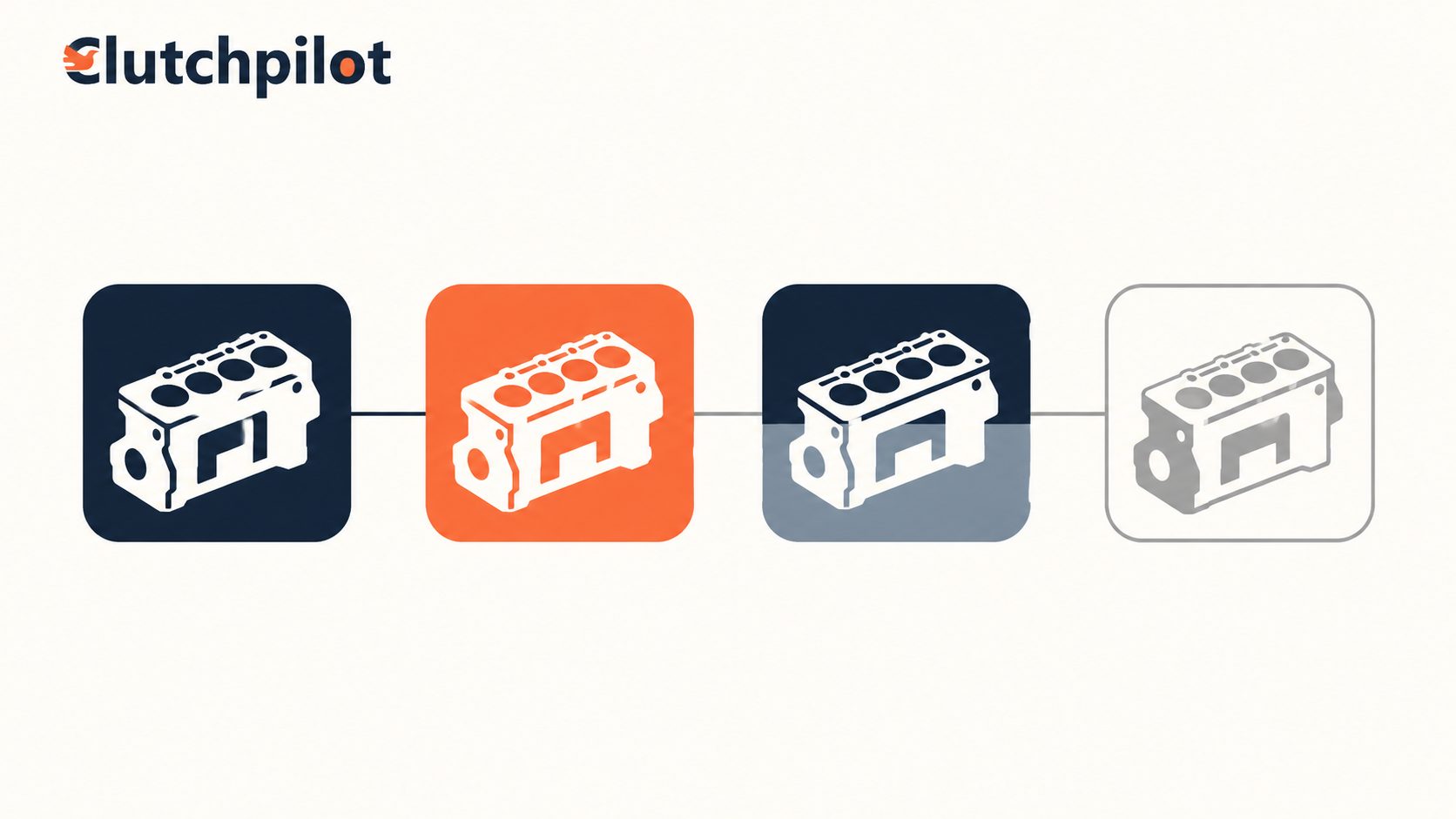
New, from the manufacturer
A factory engine, built to original specification, with a manufacturer warranty behind it.
It is the most expensive route and for a newer or higher-value car it can be the right one, particularly where the vehicle is still worth substantially more than the repair.
The practical constraint has nothing to do with budget. For many older or discontinued models a new engine is simply not available any more. Once a manufacturer stops supplying a unit, the option disappears regardless of what you are willing to spend, which is how a great many perfectly good cars end up on reconditioned or used engines by default rather than by choice.
Remanufactured
The engine is stripped completely. Every component is cleaned and inspected. Wear parts are renewed as a matter of course rather than only when they measure out of tolerance, which is the significant difference from reconditioning. Clearances, tolerances and end floats are checked at assembly, and the completed unit is tested for oil pressure and compression before it leaves.
Some remanufacturers issue a serial number with the unit, giving an audit trail of which components were renewed, when the build was completed, and what the test results were.
That last detail is worth knowing about, because it is checkable. A supplier who can produce a build record for the specific unit you are buying is making a claim you can verify. A supplier who cannot is asking you to take the word on trust.
Reconditioned, or rebuilt
Stripped down partially or fully, cleaned, damaged components replaced, reassembled.
This category contains both excellent work and indifferent work, and that is the single most important thing to understand about it. The definition permits a thorough rebuild by a skilled engineer who replaces everything questionable, and it equally permits a lighter refresh where original components measuring within tolerance are reused and aftermarket parts fill the gaps.
Neither approach is wrong. Reusing a component that measures within spec is normal engineering practice, not corner cutting, and aftermarket parts range from excellent to poor rather than being uniformly worse.
The problem is comparison. Two quotes using the word "reconditioned" can describe substantially different amounts of work at substantially different price points, and nothing in the word itself tells you which is which. That is what the questions section is for.
Used, secondhand or salvage
An engine pulled from a donor vehicle and sold as it is.
You inherit the previous owner's maintenance history, whatever that was, and usually you cannot find out what it was. Seals may be brittle, the timing chain may be stretched, the bearings may have covered 90,000 miles of short journeys. It might run happily for years. It might not.
This is a legitimate choice and this article is not going to sneer at it. On an older car with modest remaining value, where a remanufactured unit would cost more than the vehicle is worth, a used engine with a short warranty is often the only sensible economics available. Go in knowing you are buying an unknown rather than a refurbished one.
What each one costs
Price ranges for engines age badly and vary enormously by vehicle, so here is what actually drives the number rather than figures that will be wrong for half of readers.
Make and model. German marques and commercial vans generally cost more, both for the unit and for the labour to fit it.
Engine complexity. Turbocharged, diesel and hybrid units cost more than simple petrol engines, and modern engines with more integrated ancillaries take longer to remove and refit.
Supply only versus supply and fit. These are not comparable numbers, and comparing one against the other is the most common mistake buyers make. On many jobs the labour is a substantial fraction of the total.
As a rough relationship rather than a price list: reconditioned units are commonly reported as costing meaningfully less than new, with suppliers in this market typically quoting warranty periods somewhere between 6 and 24 months, and some offering longer. Used units sit below that with shorter cover or none at all.
Get three quotes, and make sure all three are for the same product on the same supply basis. That comparison tells you more than any published average.
Who supplies the engine decides who carries the risk
This is the most consequential decision in the whole purchase and it is barely discussed anywhere.
If the garage sources and fits the engine, and the engine fails, the problem belongs to the garage. They chose the supplier, they did the work, and they carry the cost of doing it a second time. You have one business to deal with and one person responsible for the outcome.
If you buy the engine yourself and hand it to a fitter, you have split that responsibility in two. The fitter owes you a competent installation. The supplier owes you a working unit. If it fails, the fitter has done nothing wrong, so you still owe them for removing and refitting, and your only recourse for the part is a supplier who is nowhere near the car.
On a job where labour alone can run well into four figures, that split is not a technicality. It is the difference between one bill and two.
This is also why a garage will sometimes decline to fit a customer-supplied engine. That refusal is easy to read as protecting a markup, and occasionally it is. More often it is a business declining to carry a risk it cannot control, because it cannot vouch for a unit it did not choose and cannot afford to do the job twice for free.
The practical guidance: on a purchase this size, supply-and-fit from one accountable party is usually worth paying something extra for. Compare your quotes on that basis rather than on engine price alone.
What a warranty should actually cover

"Twelve month warranty" tells you almost nothing. Six things do.
Duration, and whether there is a mileage cap. Twelve months or 12,000 miles is a different product from twelve months unlimited.
Whether labour is covered. This is the big one. A warranty covering the unit but not the labour to remove and refit it leaves you exposed to most of the cost of a failure. Ask explicitly, and get the answer in writing.
Whether it is transferable. If you might sell the car within the warranty period, a transferable warranty is worth real money at resale.
What voids it. Usually servicing intervals and oil specification. Occasionally something more restrictive.
Whether fitting by a non-approved garage voids it. Relevant if you are considering supply-only, and it interacts directly with the risk question above.
What the claims process is, and specifically who decides whether a failure is covered. A warranty adjudicated solely by the company that sold you the engine is a weaker instrument than one with an independent step.
Eight questions to ask a supplier
- Is this remanufactured to BS AU 257:2002, and can you confirm that in writing?
- What exactly was replaced, and what was reused?
- What testing was carried out, and can I see the results?
- Is there a serial number or build record for this specific unit?
- Does the warranty cover labour as well as the unit?
- Is the warranty transferable if I sell the car?
- Is this price supply-only or supply and fit?
- If supply-only, who carries the labour cost if it fails?
Question one does more work than the other seven combined. It is specific enough that a vague answer is itself an answer.
Warning signs
No warranty detail in writing. Verbal assurances about cover are worth nothing when you are making a claim eighteen months later.
No testing documentation, and no clear response when you ask what testing was done.
Sliding between the terms. A supplier who says "remanufactured" and "reconditioned" interchangeably within one conversation either does not know the difference or is relying on you not knowing it.
Pricing well below the rest of the market. On engines this almost always means a different product rather than a better deal.
Pressure to decide quickly, on a purchase of this size, from a business you found this week.
No traceable trading history or reviews. This one is checkable in minutes and people skip it because they are in a hurry, which is exactly when it matters most.
Before you commit
Three things decide whether this goes well.
Establish which of the four products you are actually being quoted for, in writing, using the right word.
Get the warranty terms including whether labour is covered, also in writing.
Decide deliberately whether you are buying supply-only or supply-and-fit, and understand who carries the risk in each case.
If you are still choosing who does the work, our guide to checking whether a garage is trustworthy covers the checks worth doing first, and you can browse suppliers and workshops in the automotive and vehicles category.
Comments (0)