

This article describes federal rules for interstate moves in general terms and is not legal advice. Moves within a single state are regulated by that state, so the rules below may not apply. For a dispute involving real money, speak to a lawyer or your state consumer protection office.
Most moving scams are not a moving company going bad halfway through your job.
They are a company that was never going to move your things at all. It quotes, takes your deposit, and sells the job on to whoever will take it. The reviews you read belonged to the company you booked. The people loading your truck are somebody else entirely.
Short answer: one question sorts out most of this, and it is not "are you licensed." It is "are you a carrier or a broker?" Federal law requires them to tell you, so asking is not rude, and the answer changes everything about how you should check them.
I went through the articles currently ranking for this subject. Not one of them asks that question or explains the difference. That is where this starts.
Broker or carrier? The question that predicts everything
Two different kinds of company turn up in a search for movers, and they do completely different jobs.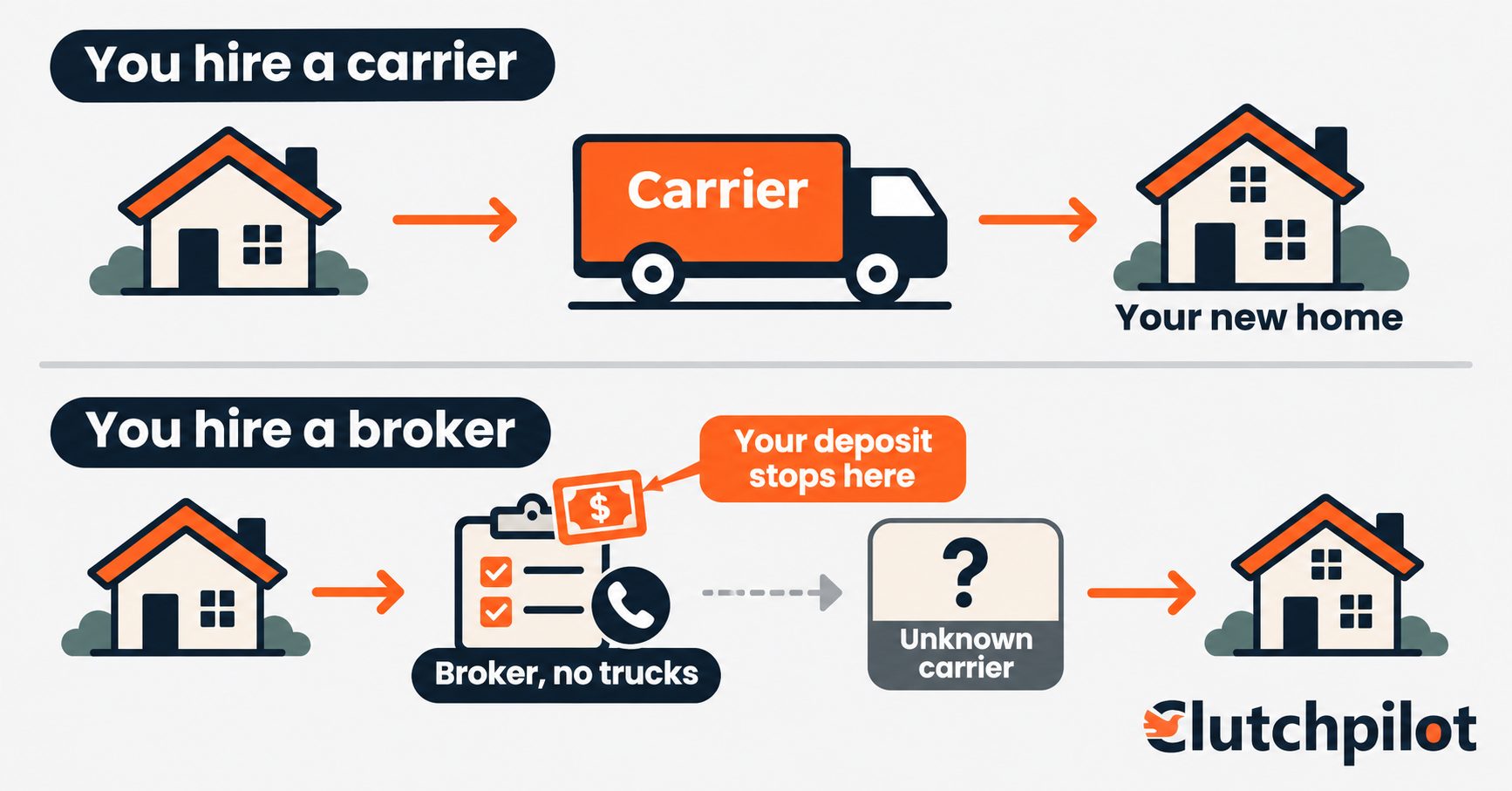
A household goods broker, in the words of the booklet your mover has to give you, "arranges for the transportation of your shipment but does not provide line-haul transportation." They sell the move. They do not own a truck and they will not be there.
A household goods carrier, the mover, actually transports your shipment.
Both must be registered with the Federal Motor Carrier Safety Administration. And a legitimate company must state which one it is.
Why this one distinction matters so much
When an undisclosed broker sits in the middle, four things happen at once.
Your deposit goes to a company with no trucks. Whatever happens next, they have been paid.
The job gets assigned to a carrier you never vetted. Possibly days before the move, possibly the night before, and often to whoever is cheapest and has capacity.
Nobody in the chain has a reputation at stake with you. The broker will not meet you. The carrier never sold you anything and does not depend on your review.
When it goes wrong, each one points at the other. The broker says the carrier failed. The carrier says the broker misquoted. Both are partly right, which is what makes it so hard to resolve.
Being fair about this
Brokers are legal, regulated, and some of them are perfectly good. A broker can give you an estimate on a carrier's behalf where they have a written agreement with that carrier and use that carrier's published tariff.
The problem is not brokerage. The problem is brokerage you were not told about. A broker who says plainly "I am a broker, here is the carrier I will assign, here is their registration" is doing nothing wrong. A company that lets you believe its own trucks are coming is already lying to you before any money has moved.
Three questions, and you can ask all of them in one email:
- Are you a broker or a carrier?
- Which carrier will actually perform my move?
- Can I have that carrier's USDOT number?
A straight answer to all three tells you a great deal. Hesitation on any of them tells you more.
How to check a mover in five minutes
- Get the legal company name, the USDOT number and the MC number. Not the trading name on the website, the registered name.
- Look them up in FMCSA's mover registration search, which is where FMCSA's own guidance and the federal regulation both send consumers.
- Confirm the registration is active, and confirm whether it is registered as a carrier or a broker. This is where question 1 above gets verified rather than trusted.
- Check the registered name matches the name on your quote. A trading name that differs is not automatically wrong, and it is worth one question.
- Look at the complaint history attached to the registration.
- Check they gave you the booklet. For an interstate move, federal law requires the mover to provide Your Rights and Responsibilities When You Move. Failing to hand it over is a red flag in itself, and reading it puts you ahead of most customers.
One honest limit. Registration confirms a company exists and holds authority to operate. It does not confirm they are any good. This check rules out the disaster, not the disappointment.
If the company is newly registered, or the name on the paperwork does not quite match anything you can find, the broader version of this check is worth ten minutes. Our guide to the nine checks that confirm a business is real covers the registry searches and the name-matching problem in more detail, and it applies to any company asking for a deposit.
Nine tactics rogue movers use
1. The firm quote with no survey
What it sounds like: a confident price over the phone or by email, without anyone seeing your belongings.
That number cannot survive contact with your actual possessions, and it is not supposed to. Its job is to win the booking.
Counter: insist on an in-home or video survey. Any mover who will not look is quoting a fantasy.
2. The undisclosed broker
What it sounds like: "we", "our crews", "our trucks", from a company that has none.
Counter: the three questions above, asked in writing so the answer exists.
3. The large deposit, paid in an irreversible way
What it sounds like: a substantial deposit to secure the date, by wire, cash, or a payment app.
The amount matters less than the method. Wires, cash and peer-to-peer apps have no dispute mechanism, which is precisely why they are requested.
Counter: pay by credit card, and treat a refusal to take one as the answer to a different question.
4. Weight bumping
What it sounds like: nothing at all, until the invoice. Charges are based on a weight you never saw established.
Counter: the weighing and reweigh rights further down. They exist specifically for this.
5. Lowball, then escalate
What it sounds like: a number clearly below everyone else, followed by new charges once the truck is loaded.
The timing is the tactic. Your leverage is at its lowest when your possessions are already on their vehicle.
Counter: compare what each quote excludes rather than what it totals, and understand which kind of estimate you have signed.
6. The hostage load
What it sounds like: the truck arrives at your new home and the price has gone up. Pay now or the doors stay shut.
Federal law is unusually clear here, and the next section covers exactly what you can demand.
Counter: know the 110 percent threshold before moving day, not during it.
7. The blank or incomplete bill of lading
What it sounds like: "just sign here, we'll fill in the rest later." Often while a crew stands waiting.
The bill of lading is your contract. Signing one with the numbers left open signs away the argument before you have had it.
Counter: no blanks, no signature. The crew can wait.
8. Generic branding and no real presence
What it sounds like: a company name that reads like a search phrase, an unmarked or rented truck, no verifiable physical address, and no local footprint.
Counter: the registration lookup, plus a street address you can actually find.
9. "Insurance" that is not insurance
What it sounds like: "you're fully covered, don't worry."
What movers provide is valuation coverage, not insurance, and the default level is dramatically lower than almost anyone assumes. This has its own section below because the numbers are genuinely shocking.
The estimate rules, and what they mean on delivery day
The three kinds of estimate
Binding. A fixed price for the items and services listed. If your inventory does not change, neither does the price.
Non-binding. An approximation. Final charges are based on actual weight and the services actually performed. This is not a price, and it binds nobody.
Not-to-exceed. A ceiling. You pay the lower of the estimate or the actual cost. This is the most consumer-friendly and the least often offered, so ask for it by name.
Most disputes start with a customer who believed a non-binding estimate was a quote. There is nothing improper about a non-binding estimate as long as you know which one you signed.
The 110 percent rule
This is the most useful thing in this article and it is written into federal regulation.
Under a non-binding estimate, the mover cannot require you to pay more than 110 percent of that estimate at the time of delivery. Anything beyond that gets billed later, after 30 days from delivery.
And here is the part to remember if a truck is ever parked outside your new home with your life inside it. Your mover must give you possession of your shipment if you pay 110 percent of a non-binding estimate, or 100 percent of a binding estimate, plus any applicable impracticable operations charge.
If they refuse, the regulation itself does not hedge. Federal regulation calls that holding your shipment hostage, in violation of federal law.
That is not a consumer group's characterisation or ours. It is the text of 49 CFR Part 375 Appendix A, and it is worth knowing you can say it out loud.
What your belongings are actually covered for
Every article on this subject mentions moving coverage. None of the ones ranking for it explains what the levels mean. Here is the explanation, and it is the section most likely to change what you actually do.
Released value protection
Costs you nothing, and it is frequently the default if you do not actively choose otherwise. Under it, the mover assumes liability for no more than 60 cents per pound, per article.
Per pound. Not per item, and nothing to do with what the thing is worth.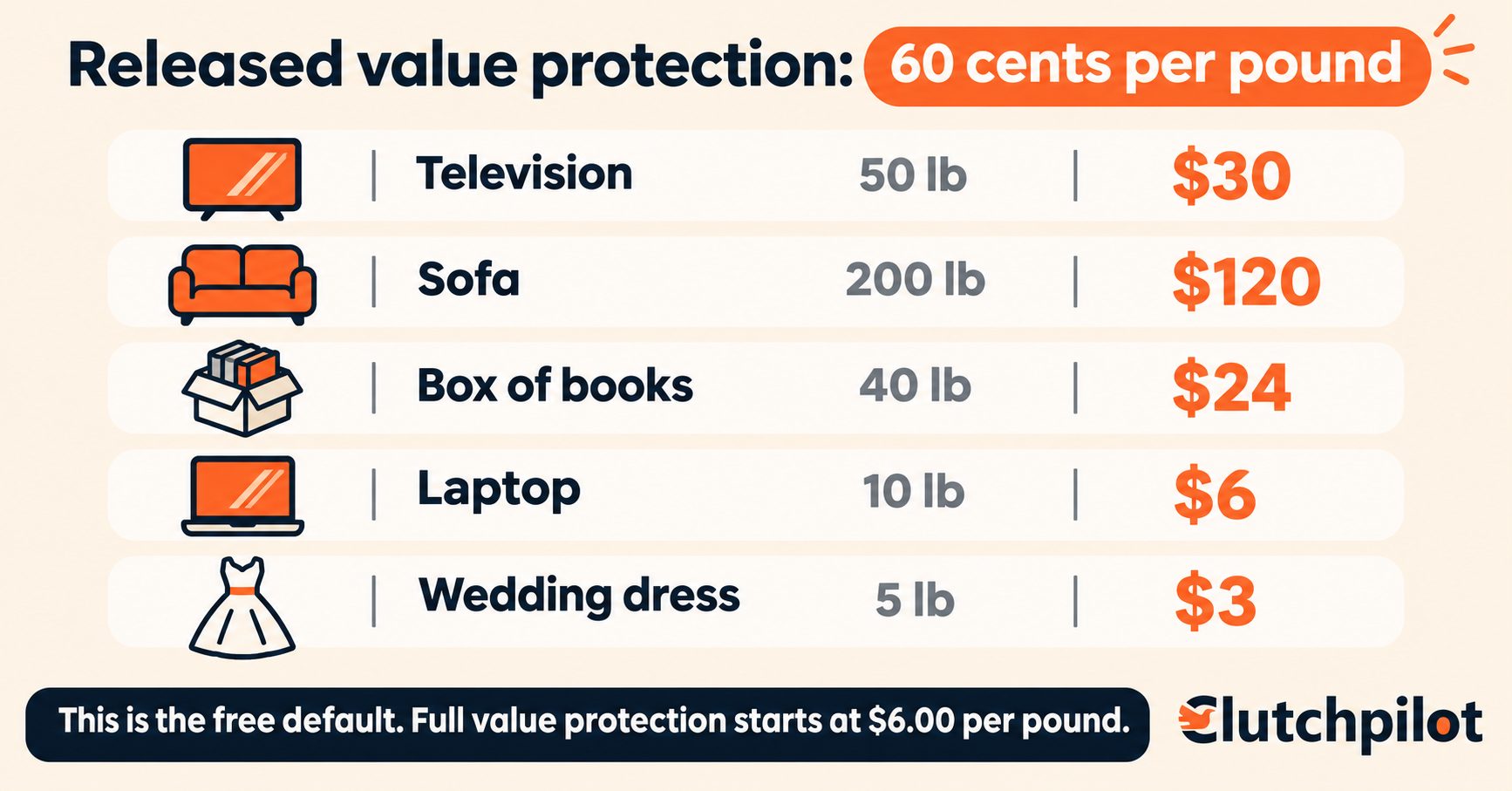
Run the numbers on your own belongings:
| Item | Rough weight | Covered for |
|---|---|---|
| Television | 50 lb | $30 |
| Laptop | 10 lb | $6 |
| Sofa | 200 lb | $120 |
| Box of books | 40 lb | $24 |
| Wedding dress | 5 lb | $3 |
That is the free option. It is not a scam, it is the legal minimum, and a great many people accept it without ever being told what it means.
Full value protection
Costs extra, and your written estimate must include it unless you waive it in writing. The minimum valuation is $6.00 per pound multiplied by the weight of your entire shipment, and movers may set higher minimums or allow a higher declared value for more money.
Two details almost nobody covers:
Items worth more than $100 per pound must be declared in writing to be fully recoverable. Jewellery, cameras, musical instruments, small electronics. If they are not on a high value inventory, they are not covered at their value.
A claim for loss or damage must be submitted in writing within nine months of delivery. Miss the window and the strength of your case stops mattering.
The word that causes the confusion
This is valuation coverage, not insurance. Movers are not insurers and are not selling you an insurance policy. If you want actual insurance for a move, that is a separate product bought from an insurance company, and for a high-value household it is worth pricing.
Weighing, and your right to a reweigh
The direct counter to weight bumping, and I could not find a single page ranking for this keyword that explains it.
"You have the right, and your mover must inform you of your right, to observe all weighing of your shipment."
The mover has to tell you where and when each weighing will take place and give you a reasonable opportunity to be there. You can waive that right, but only in writing, which means it cannot be waived by the crew simply not mentioning it.
And if you believe the origin weight is wrong, you can request a reweigh before your shipment is unloaded. You cannot be charged for the reweigh, and the final charges are then based on the reweigh result.
One honest caveat: the reweigh result stands even if it comes out higher than the original. This is a right worth using when you have a real reason to doubt the weight, not a free roll of the dice.
The paperwork that protects you
The written estimate. Stating plainly which of the three types it is. If you cannot tell from the document, ask and get the answer in writing.
The inventory. Checked by you at both ends. Note existing damage before loading, because anything not noted at origin becomes an argument at destination.
The high value inventory. Separate, for anything over $100 per pound.
The bill of lading. This is your contract with the carrier. Read it, and never sign one with blank spaces where numbers belong.
The booklet. Which they are required to give you, and which is more useful than it looks.
The single most expensive avoidable mistake in a move is signing a bill of lading with the figures left open because a crew is standing in your hallway waiting. That pressure is deliberate.
Two practical habits make the paperwork actually work for you. Photograph every document after signing, on your own phone, because the copy you are handed can go missing and the one they keep is the one that gets quoted back at you. And write the date and time next to your signature wherever there is room, which matters later if the sequence of events is disputed.
If they are holding your goods
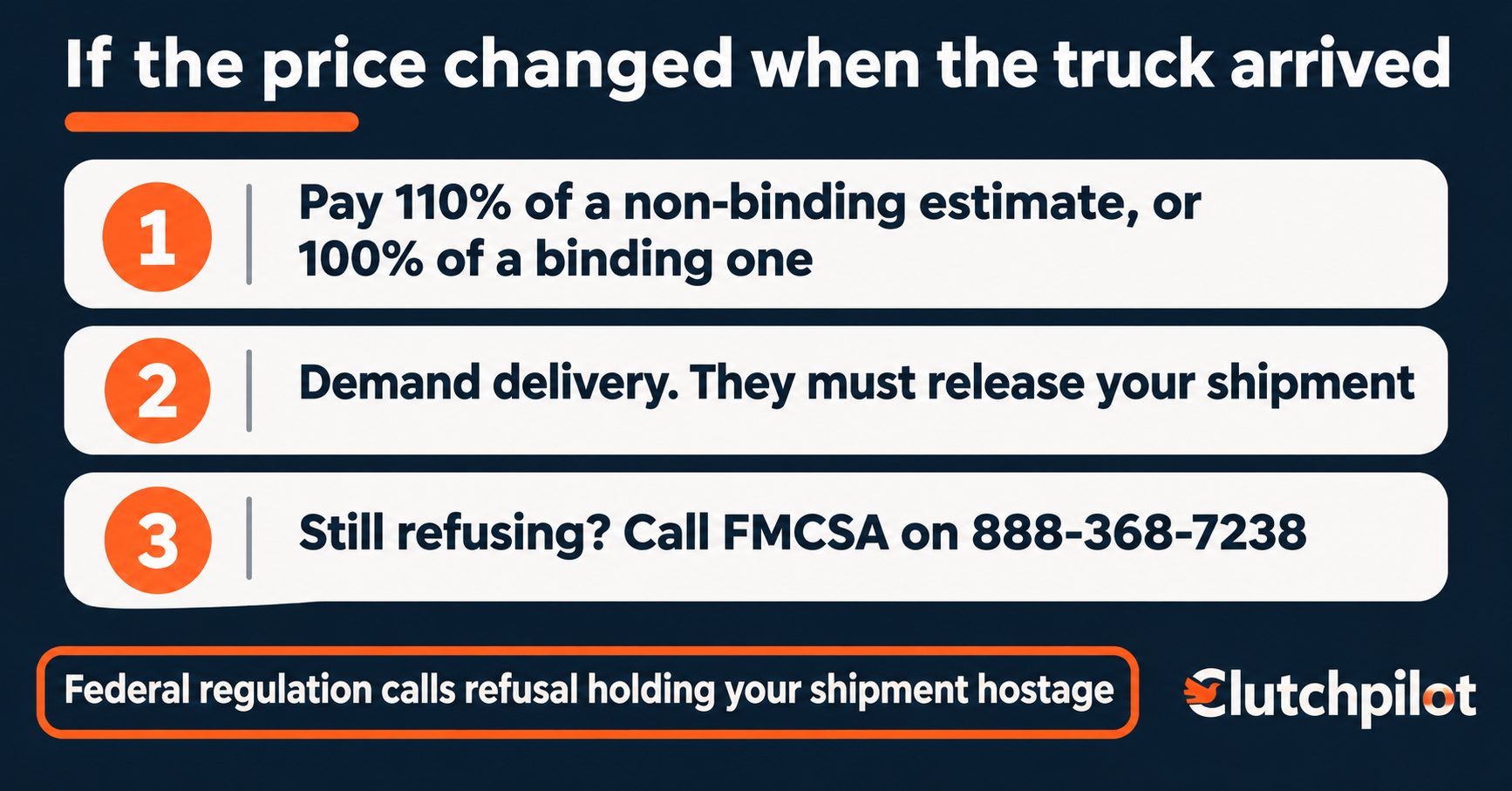
Pay the threshold and demand delivery. 110 percent of a non-binding estimate, or 100 percent of a binding one, plus any applicable impracticable operations charge. That is the point at which they must release your shipment, so paying it is not giving in, it is establishing that any further refusal is unlawful.
Document everything in writing. What was demanded, by whom, when, and what you paid. Photograph the truck and the paperwork.
Contact FMCSA immediately on (888) 368-7238 if the mover will not deliver unless you pay an amount they are not entitled to charge. That number is published in FMCSA's own booklet for precisely this situation.
Then pursue the money. A written claim to the mover within nine months for loss or damage, a dispute with your card issuer if you paid by card, and a complaint to your state attorney general.
Do not let a crew talk you out of the first step. The threshold is a number, not a negotiation.
Three things to settle before moving day
Confirm carrier or broker, in writing. One email, three questions, and most of the risk in this article disappears.
Know which kind of estimate you signed. Binding, non-binding or not-to-exceed, and the number that follows from it.
Choose your valuation coverage deliberately. Sixty cents per pound is a decision, even when you make it by saying nothing.
Comments (0)