


This question has two different answers depending on who is asking, and most articles about it only answer one.
If you are a consumer trying to judge whether a company is trustworthy: the accredited seal is not the signal you probably think it is. By BBB's own statement, accreditation is voluntary, it is separate from the rating, and paying dues does not buy a better grade. A business can hold an A+ without paying anything. So the rating and the complaint history are what you want to read, and the seal mostly tells you the business pays dues.
If you are a business owner deciding whether to pay: it is a marketing decision rather than a credibility decision, for exactly that reason. You can earn the same A+ without it. Whether the dues pay for themselves depends almost entirely on whether your own customers check BBB before they buy.
The reason this question gets asked so often is a genuine controversy from 2010, which BBB responded to by changing the specific thing that caused it. That history matters, because knowing it is what lets you read the current position correctly. It is covered below.
What BBB accreditation actually is
Accreditation means a business applied, paid dues, and committed to BBB's eight Standards of Trust:
- Build trust. Establish and maintain a positive track record in the marketplace.
- Advertise honestly. Follow legal and ethical advertising and selling practice, including BBB's Code of Advertising.
- Tell the truth. Honestly represent products and services, including clear and prominent disclosure of all material terms.
- Be transparent. Openly disclose who the business is, where it is located and who owns it.
- Honor promises. Fulfil all contracts, commitments and representations.
- Be responsive. Address disputes forwarded by BBB quickly and in good faith.
- Safeguard privacy. Protect collected data, collect only what is necessary, and respect customer preferences.
- Embody integrity. Deal in good faith and avoid conduct that reflects badly on BBB.
To qualify, a business also needs a record of delivering on its promises, a B rating or better, and at least six months of serving customers.
Two observations worth making about that list.
Standard 6 is the one with teeth. An accredited business has committed to responding to complaints BBB forwards. That is a real benefit to a customer, even if a modest one, and it is the most concrete thing accreditation actually delivers.
Standard 8 protects BBB as well as you. "Avoid conduct that reflects badly on BBB" is a reasonable membership condition and it is not a consumer protection. Worth noticing rather than objecting to.
Accreditation and the rating are two different things
This is the part almost nobody knows, and it changes how you should read a BBB profile.
BBB states that accreditation is voluntary and separate from the rating. On the same page it says that accreditation dues do not buy a rating, and that a business can earn an A+ without being accredited, because the rating depends on complaint history and customer interactions rather than on paying dues.
That is BBB's own position, on BBB's own site. It is not a criticism from outside.
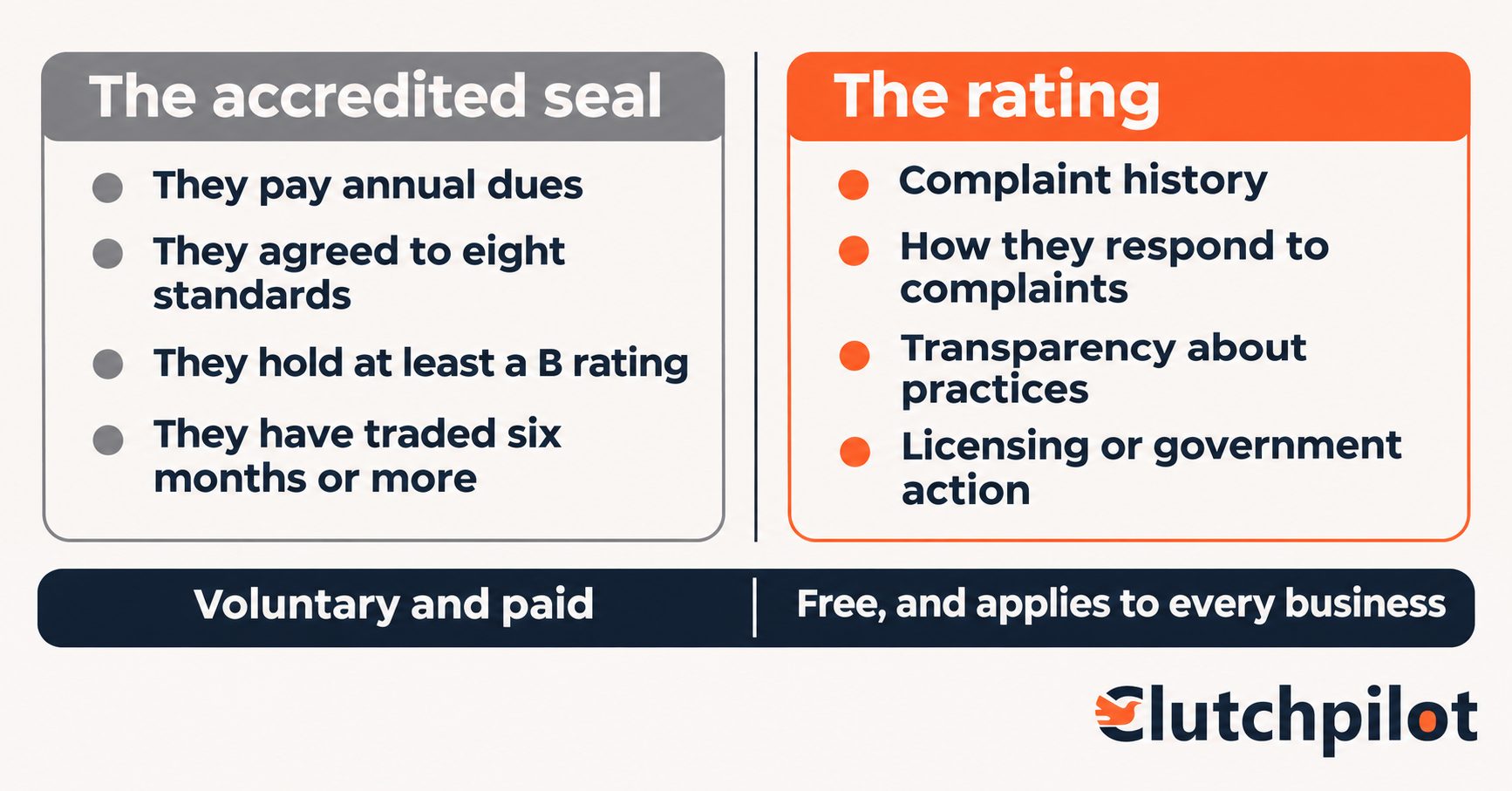
What the seal means: they pay dues, they agreed to eight standards, they hold at least a B rating, and they have traded for six months or more.
What the seal does not mean: that BBB investigated them, verified their work, inspected anything, checked their licensing for your job, or graded them above an unaccredited competitor.
The consequence, and it is worth stating bluntly. An unaccredited business with an A+ has a better conduct record than an accredited business with a C, by BBB's own measure. If you are choosing between two companies and one has the seal, the seal is the least informative thing on either profile.
Now the counterweight, because dismissing accreditation entirely would also be wrong. The eight standards are reasonable commitments. The promise to answer complaints is real. And in some industries the seal genuinely does reassure customers, which is a fact about customer behaviour rather than about business quality. Accreditation is simply not a quality verification, and that is what most people believe they are reading.
What the rating actually measures
BBB bases its A+ to F rating on four things:
- The business's complaint history
- How it responds to complaints
- Transparency about its business practices
- Any licensing or government action taken against it
And here is the second thing that surprises people: customer reviews do not affect the rating. BBB says so directly.
That is worth sitting with, because it is counterintuitive. A business can carry a wall of furious one-star customer reviews on its BBB profile and still hold an A+. Reviews and complaints are separate systems on the same page. A complaint is a formal filing that BBB forwards to the business for a response. A review is an opinion somebody posted.
So a BBB profile shows you two independent data sets, and the letter grade summarises only one of them.
For a consumer: read the complaints and the reviews separately, and treat the grade as a summary of complaint handling rather than of customer satisfaction.
For a business: the lever on your grade is responding to complaints, not gathering reviews. That also happens to be free.
Why people ask this question at all
The scepticism around BBB accreditation is not invented, and the honest version of this article has to deal with it.
When BBB launched its letter-grade system in 2009, accreditation contributed four points toward a business's rating. Paying for accreditation improved the grade directly.
In 2010, an ABC News 20/20 investigation reported that fabricated companies received high ratings shortly after paying membership fees. Connecticut's Attorney General criticised the arrangement as misleading. Critics also pointed out that accredited businesses were consistently grading higher than unaccredited ones, and raised questions about executive compensation at some local BBBs.
BBB responded by removing accreditation from the points system, and said it would no longer give better grades to paying members.
Two things follow from that, and both are true at once.
The criticism was legitimate, and the specific problem was fixed. The "accreditation does not buy a rating" position that BBB publishes today exists because of that episode. Presenting a resolved 2010 issue as the current state of affairs would be inaccurate.
The structural tension has not gone away. BBB is a private non-profit, organised as a 501(c)(6) and founded in 1912, operating through 92 independently incorporated local BBBs in the US and Canada under the International Association of Better Business Bureaus. Funding comes almost entirely from dues paid by accredited businesses.
An organisation funded by the businesses it rates has an inherent conflict of interest. BBB has separated the two mechanisms, which is the right response, and the funding model is still what it is. You can hold both of those thoughts.
What it costs
BBB does not publish a rate card, which is itself worth knowing.
Dues vary by local BBB and by business size, and the actual rate is typically only shown after you apply. FitSmallBusiness reported roughly $965 a year for a business with ten employees, as of February 2025. Treat that as one reported example rather than a national price, because the 92 local organisations set their own rates.
The practical step is to ask your own local BBB for a quote, then compare it against what the same money buys elsewhere. There is no way to shortcut that, and anyone quoting you a confident national figure is guessing.
For consumers: how to read a BBB profile properly
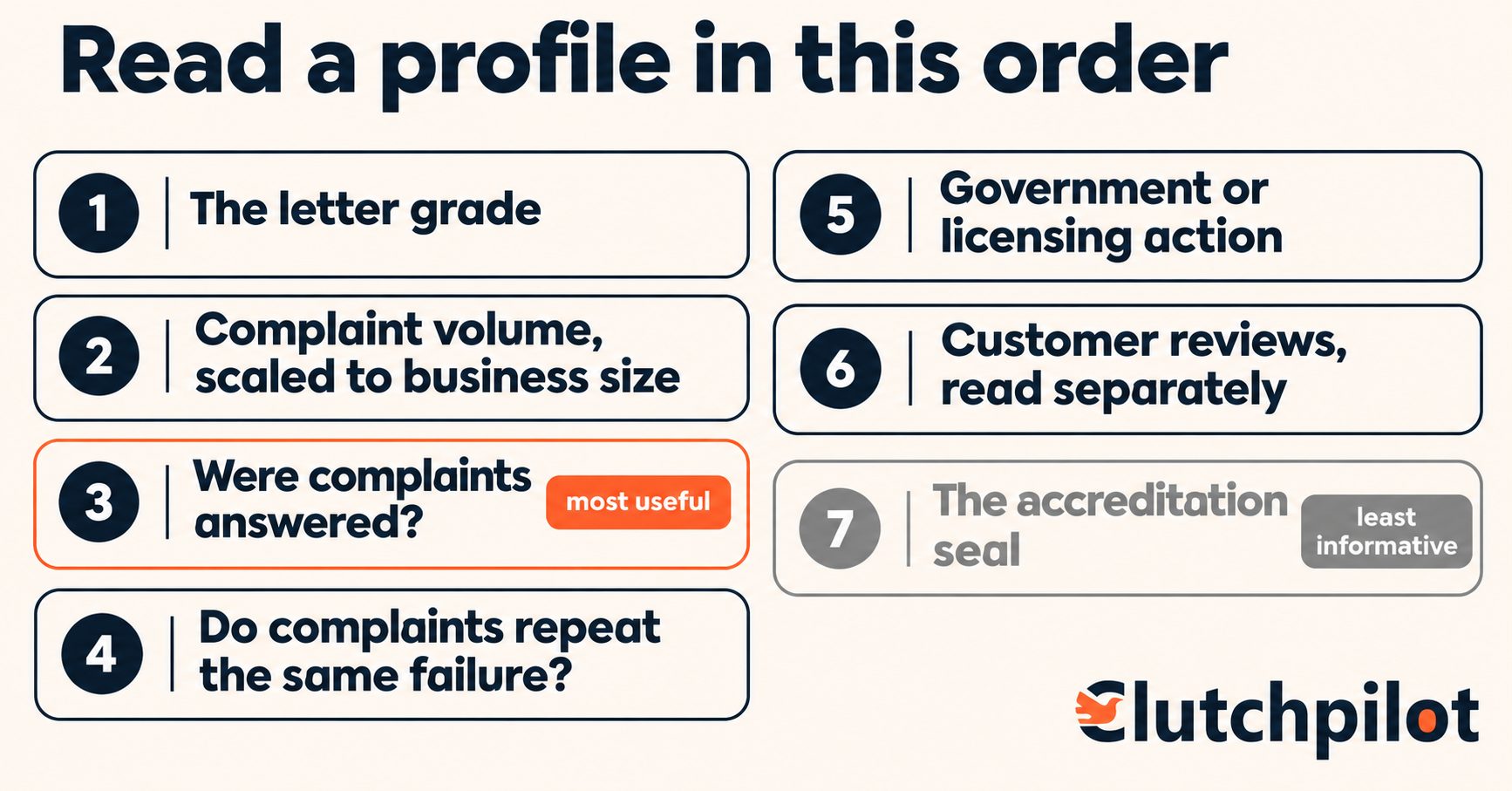
The half of this question that nobody seems to write about. Here is the order to look at things, which is not the order the page presents them.
1. The letter grade. Remembering that it reflects complaints, responsiveness, transparency and government action, and not reviews.
2. Complaint volume relative to business size. Twelve complaints against a two-person operation and twelve against a national chain are completely different signals. Scale the number before you react to it.
3. Whether complaints were answered. This is the single most useful thing on the page. A business that answers complaints is a business you can reach when something goes wrong. A pattern of unanswered filings tells you what will happen to your email.
4. Whether complaints repeat the same failure. Scattered complaints about different things are ordinary business. The same complaint twenty times is a system, not an accident.
5. Government action or licensing problems. These feed the grade and they deserve reading in full rather than skimming.
6. Customer reviews, as a separate exercise. They do not touch the grade, so read them for texture and not as an explanation of the letter.
7. The accreditation seal, last. Read it as "pays dues and agreed to standards," which is what it is.
What a BBB profile cannot tell you: whether the work is any good, whether the price is fair, or whether the business holds the right licence and insurance for your particular job. BBB is one input among several, and for a trade job the licensing board matters more.
The sentence to take away: an unaccredited business with an A+ and a clean record of answered complaints is a better bet on this evidence than an accredited business with a C and a pattern of ignoring people.
For businesses: when it is worth paying
No single verdict, because the answer genuinely differs by market. Here are both cases and then a way to decide.
The case for it:
- Some customer segments, skewing older, do check BBB before buying, and in those segments the seal carries weight
- In home services, contracting, roofing, moving and similar trades, BBB has more standing than in most sectors
- The profile and seal are usable marketing assets, and some customers specifically search BBB directories
- BBB's dispute mediation is occasionally useful to the business as well as the customer
- For a new business with no review history anywhere, almost any third-party signal helps
The case against it:
- You can earn the same A+ without paying, which is the decisive argument and the one no vendor article makes
- Google reviews reach far more prospective customers than a BBB profile does for most businesses
- The dues recur annually, so the real question is whether they beat the same spend on anything else
- Younger customers largely do not consult BBB
- In B2B, technology and professional services, the seal carries little weight
How to decide, in four steps:
- Search your own business name and see whether your BBB profile even appears on the first page. If it does not, the seal is invisible to the people you are trying to reach.
- Ask five recent customers whether they checked BBB. That is the entire answer for your market, and it costs you five conversations.
- Get the dues quote, then compare it honestly against the same amount spent on local search, review generation or photography.
- Either way, claim your free profile and answer complaints. That is what moves the grade, it costs nothing, and it is the part most owners neglect while debating the dues.
What BBB can and cannot do
BBB states that it is not a government agency and holds no regulatory power.
It cannot fine a business, license one, suspend anything, compel a refund, or impose any sanction. What it can do is forward your complaint, publish the outcome, and maintain a public record that other customers can read.
For actual enforcement you need a regulator, a state licensing board or a state attorney general, which is a different process with real leverage behind it. Our guide to confirming a business is real covers the licence and registry checks that matter more than any seal.
Where BBB sits among the other trust signals
Useful context for both audiences, because the question is never really "is BBB good." It is "what should I rely on instead, or as well."
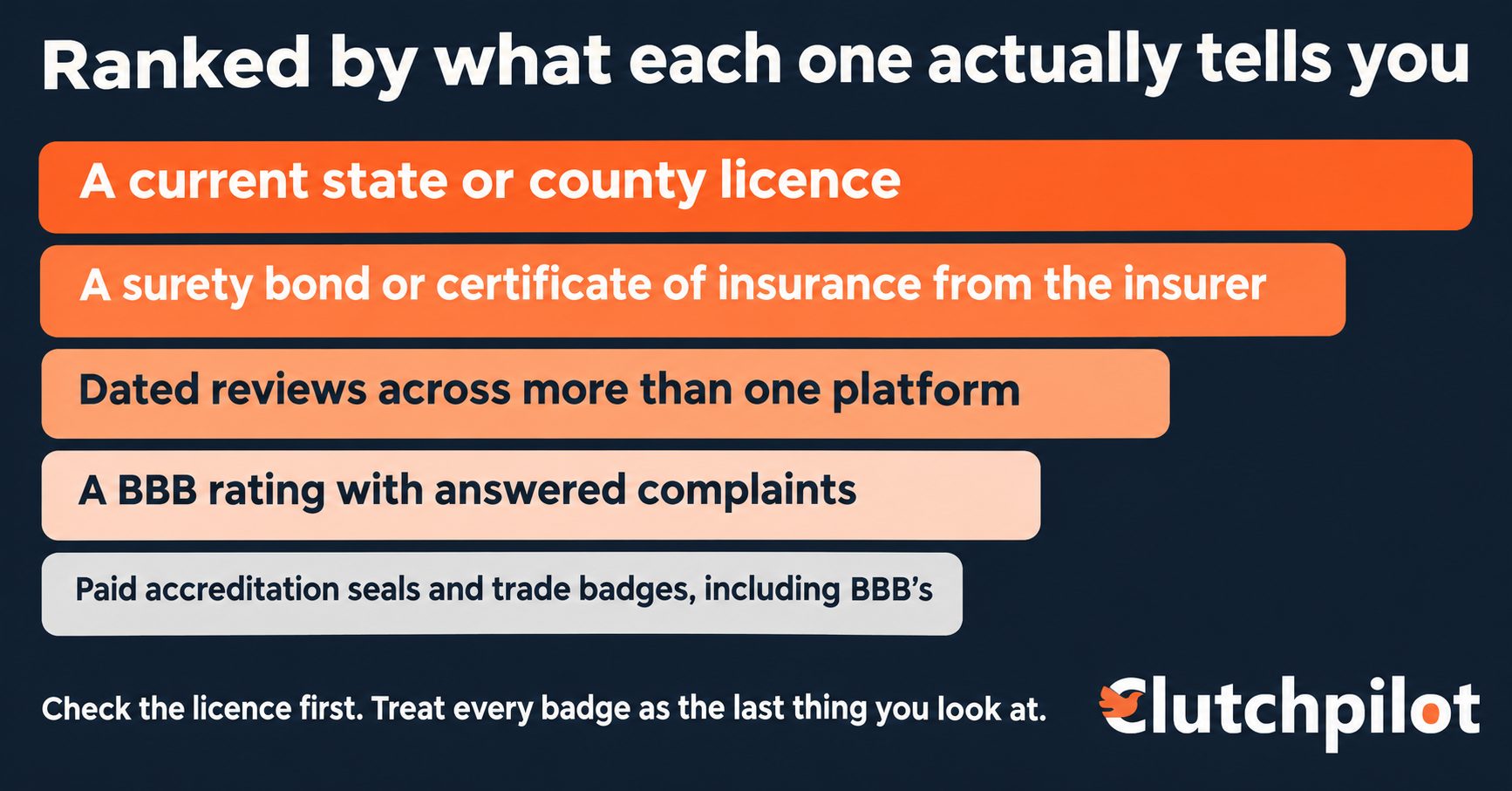
Ranked by how much each one actually tells you about a business:
A current state or county licence, where the trade requires one. The strongest signal available, because it is issued by a body that can take it away. Verify it with the issuer rather than accepting a certificate.
A surety bond or a certificate of insurance sent to you directly from the insurer. Not a trust signal exactly, more a measure of what you can recover if things go wrong, which is often the more practical question.
A volume of dated reviews across more than one platform. Fifty reviews spread over three years on a public platform is harder to manufacture than a wall of five-star entries appearing in one month. Google reaches the most people for most businesses, which is why it matters more than any single directory.
A BBB rating with answered complaints. Genuinely informative, for the reasons set out above, and free to check.
Trade association membership and accreditation seals of any kind, including BBB's. Worth the least on their own, because almost all of them are paid memberships rather than inspections. That applies to BBB accreditation and it applies equally to most industry badges you will see in a footer.
None of these replaces the others. The practical approach is to check the licence first, then the reviews, then the complaint record, and treat every badge as the last thing you look at.
The short version
Consumers: read the grade, scale the complaint count against the size of the business, check whether complaints were answered, and treat the seal as a dues receipt rather than a verification.
Businesses: claim the free profile and answer complaints, because that is what moves your grade. Buy the accreditation only if your own customers tell you they check.
Comments (0)