


Reporting a scam and getting your money back are two different jobs, handled by two different sets of people. Almost every guide to this subject blurs them together, and that is why so many people spend an afternoon filing complaints and never see a refund.
The money route runs through whoever moved the payment: your card issuer, your bank, the payment app, the wire company, the gift card issuer. This is where refunds actually come from.
The reporting route runs through government agencies. This is where enforcement comes from, and it is how the business gets stopped from doing it to the next person.
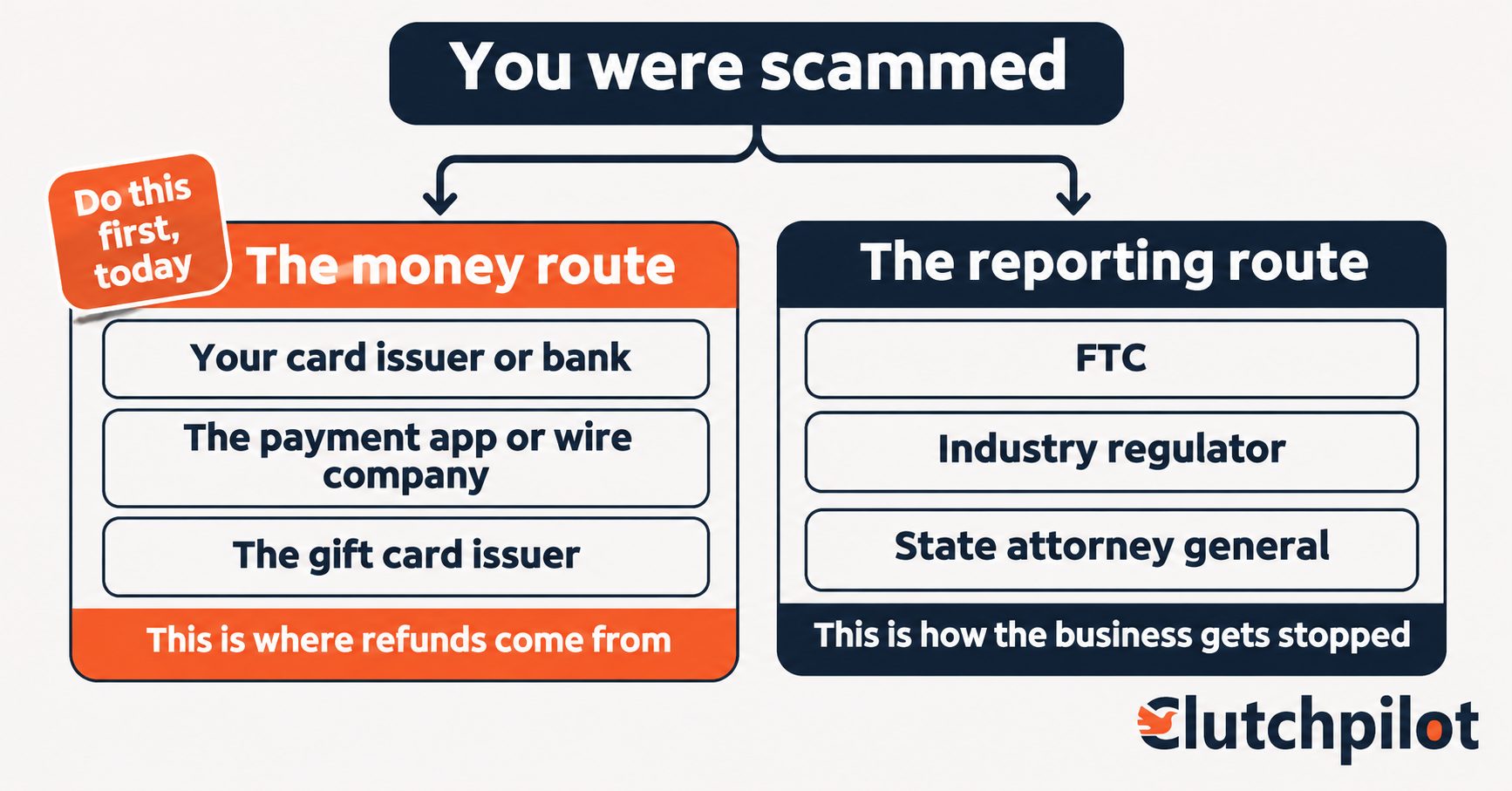
Do both. Do them in that order.
Short answer: call your payment provider today, then report to the FTC, then report to the specific regulator for that industry, then your state attorney general.
One thing worth knowing before you start. Most agencies will not resolve your individual case, and will not write back. One of them forces the company to respond to you within 15 calendar days. That one is covered below, and most people have never heard of it.
First, the money route
Contact whoever handled the payment, immediately, and ask for a reversal or refund. This is the FTC's own payment-by-payment recovery steps, and in nearly every case the instruction is to go to the company that moved the money.
- Credit card. The issuer, using the number on the back of the card.
- Debit card. Your bank or credit union.
- Bank transfer or Zelle. Your bank, immediately, and ask them to reverse the payment.
- Payment app, including Venmo, Cash App and PayPal. Report it in the app and ask them to reverse it.
- Wire transfer through Western Union or MoneyGram. The wire company. Say a scammer tricked you and ask for a refund.
- Gift card. The gift card issuer, using the number on the back of the card. Say a scammer tricked you into giving them the number and PIN. Keep the card and the receipt.
- Cryptocurrency. The exchange or the ATM operator, immediately, saying the transaction was fraudulent. Be realistic here, because crypto does not carry the legal protections cards do and recovery is genuinely difficult.
- Cash sent by US mail. The US Postal Inspection Service on 1-877-876-2455. For a fee they can intercept a domestic package that has not yet been delivered. For FedEx or UPS, contact them as fast as you can.
That last one is the least known item on this page and occasionally the most useful. If you posted cash or a cashier's cheque yesterday, call that number before you read the rest of this.
How you paid also determines how strong your position is, which is a separate subject covered in our guide to confirming a business is real and the payment protections that go with it.
Which agency handles what
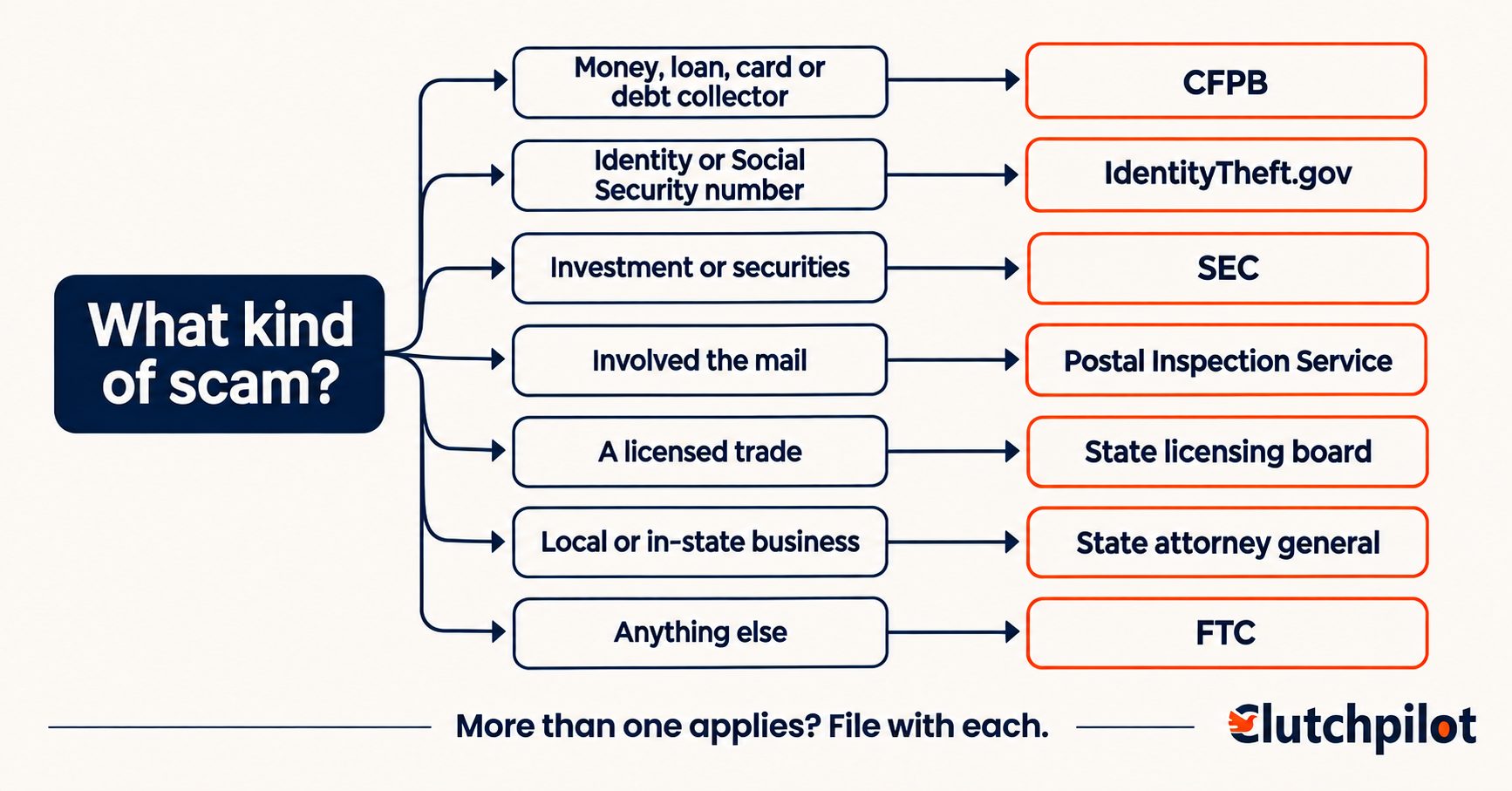
The right agency depends on what kind of scam it was. This is the part no page seems to lay out properly.
| Situation | Where to report |
|---|---|
| Any scam or fraud, general | FTC, at reportfraud.ftc.gov |
| Anything where the internet was involved | FBI Internet Crime Complaint Center, ic3.gov |
| Your identity or Social Security number was used | identitytheft.gov |
| Banks, credit cards, loans, mortgages, debt collectors, credit reports | CFPB, at consumerfinance.gov/complaint |
| Mail, or anything sent by post | US Postal Inspection Service, uspis.gov |
| Investments, securities, Ponzi schemes | SEC, at sec.gov/tcr |
| Brokers and brokerage firms | FINRA, finra.org |
| Commodities, futures, some crypto products | CFTC, cftc.gov |
| Robocalls, spam texts, unwanted calls | FCC, consumercomplaints.fcc.gov |
| Someone impersonating the IRS | IRS, irs.gov |
| Someone impersonating Social Security | SSA Office of the Inspector General, oig.ssa.gov |
| Medicare or Medicaid fraud | HHS Office of the Inspector General, oig.hhs.gov |
| Interstate movers | FMCSA, at protectyourmove.gov |
| Airlines and ticketing | US Department of Transportation |
| Insurance | Your state insurance commissioner |
| Licensed trades: contractors, electricians, salons, care providers | Your state licensing board |
| A local business, an in-state dispute, or anything else | Your state attorney general |
If more than one row applies, file with more than one. There is no penalty for duplication and the agencies share data.
The federal agencies, and what each actually does
The FTC
Where: reportfraud.ftc.gov
What happens to your report. The FTC says its investigators use the information to build cases against scammers, that it sues them and works to shut them down, and that other law enforcement agencies can see the reports and use them in their own investigations.
What does not happen. The FTC will not resolve your individual complaint and will not get your money back. Its own explanation of why to report describes building cases, not issuing refunds. You will almost certainly not hear from them.
So why do it. Because volume is the only thing that triggers enforcement. The state lawsuits against home repair contractors we have written about elsewhere were built out of 24 complaints in one case and 80 in the other, filed by people who assumed nothing would come of theirs. Your report is one row in that evidence.
The CFPB
Where: consumerfinance.gov/complaint
This is the most useful route on this page, and the reason is specific.
Scope: banks, credit cards, loans, mortgages, debt collection, credit reporting, money transfers, prepaid cards. Financial products and the companies that provide them.
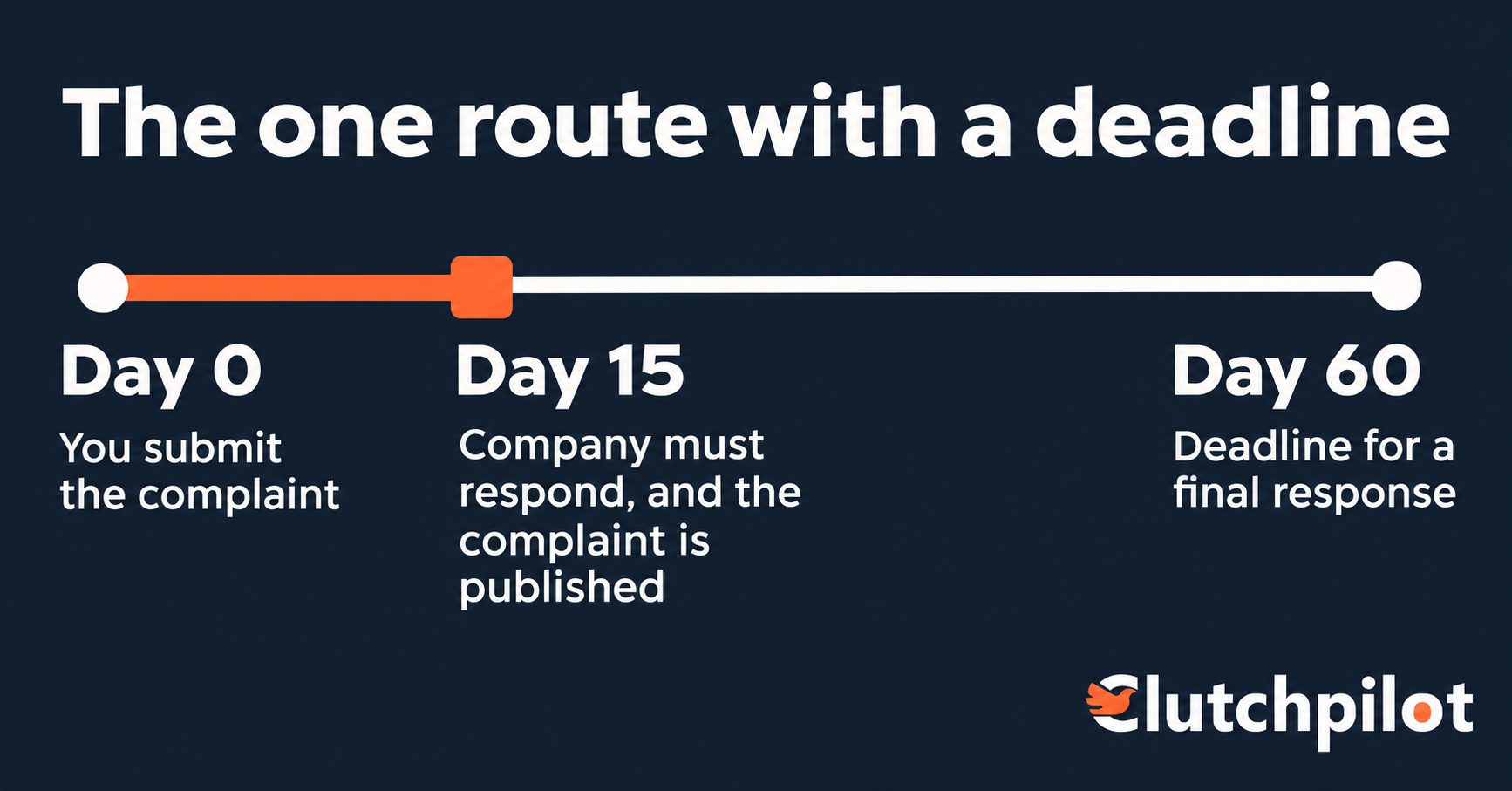
What makes it different. The CFPB routes your complaint into the company's own portal, and the company provides a response within 15 calendar days. If that first response is not final, the company has up to 60 calendar days to give a final one. The CFPB then invites you to review what the company said and passes your feedback back to them.
And it becomes public. Eligible complaints are published in the CFPB's Consumer Complaint Database, after the company responds or after 15 calendar days, whichever comes first, provided the complaint meets the publication criteria.
Put those two things together. A deadline, plus a public record attached to the company's name. That combination gives a regulated business a concrete reason to deal with your case specifically rather than filing it. No other route described here does that.
The limit. It only covers financial products. A roofing contractor who took your deposit is out of scope, however badly they behaved. If a bank, a card issuer, a lender or a debt collector is anywhere in your story, this is your strongest move.
The FBI's IC3
Where: ic3.gov
Scope: internet crime of any kind, which in practice now covers most scams.
File here whenever the internet was involved, and file fast if you sent a wire transfer or cryptocurrency. Quick reporting occasionally supports a recovery attempt while the funds are still traceable, and that window is measured in hours rather than days.
Expect no reply. IC3 is an intake point for investigations, not a customer service function.
IdentityTheft.gov
Where: identitytheft.gov
This is separate from a general FTC fraud report and people routinely conflate the two.
Use it when your personal details were taken rather than just your money: your Social Security number, accounts opened in your name, a tax return filed by somebody else. It produces a personalised recovery plan and an identity theft report you can use with creditors and the credit bureaux, which an ordinary fraud report does not give you.
If a scam involved both money and your identity, file in both places.
The Postal Inspection Service
Where: uspis.gov, and 1-877-876-2455
Scope: anything that touched the mail, which includes a surprising share of fraud against older people in particular.
These are federal law enforcement officers with real investigative powers, and they are badly under-used by consumers. They also have the package interception option described earlier, which is the only mechanism on this entire page that can physically stop money in transit.
Your state: the two routes most people skip
Your state attorney general
The single most under-used route for an ordinary business dispute.
Every state attorney general runs a consumer protection division. Many of them will attempt mediation with the business on your behalf, which is a genuine service that federal agencies do not offer. They also bring the cases that close bad operators down, because consumer protection enforcement mostly happens at state level.
Here is the practical difference. A federal agency handles patterns. A state attorney general will sometimes handle you.
Search for your state's name plus "attorney general consumer complaint" to find the right form.
Your state licensing board
If the business holds a licence, the body that issued it can suspend or revoke it.
For a contractor, an electrician, a plumber, a mover, a salon, a care provider or anyone in a regulated trade, this is frequently the most powerful lever a single customer has. The reason is simple: the business has something concrete to lose, and that makes them responsive in a way that a complaint to a federal agency does not.
Two things to check. Whether the trade is licensed in your state at all, because requirements vary enormously and in some states general contractors are not licensed. And whether the licence is bonded, because a surety bond can be an actual route to compensation rather than just a disciplinary outcome.
The ones that are not regulators
Worth knowing, because many people file here first and then wonder why nothing happened.
The BBB Scam Tracker is useful and is not a government agency. The Better Business Bureau cannot compel a business to do anything. Its value is the public record and the warning it gives the next person.
Review platforms, including Google, Yelp and Trustpilot, are not enforcement either. Leaving an accurate, factual review is worth doing. It is not a report.
Social media platforms will sometimes remove a scam account or advert. That protects other people and does nothing for your money.
All of these are worth five minutes after you have done everything above, not instead of it.
What to put in a report
An incomplete report is a report that goes nowhere. Gather this before you start filling in forms, and you will only have to do it once.
- The business name, any trading name, the website address, and every phone number you have
- Names of any individuals you dealt with
- Dates: first contact, the payment, the promised delivery or completion
- Exactly what you paid, how you paid it, and the amount
- What you were promised, and what you actually received
- Every message in full, rather than your summary of it
- Screenshots of the website, the listing, and the order confirmation
- Any reference numbers you already hold, including a police report number
The item people leave out is how you paid, and it is often the detail that determines which agency has jurisdiction.
Keep all of it even after you have filed. If the business is eventually sued, the people with documentation are the people who get included in a restitution order.
What reporting actually achieves
Here is the honest version, because every other page on this subject implies more than it should.
What it usually does not do. Get your money back. Produce a reply. Result in anything you can see happening.
What it does do. It builds the record that enforcement runs on. Agencies act on patterns, and a pattern is nothing more than individual reports stacked up. One complaint is noise. Two dozen is a case, and cases are how businesses like this stop operating.
The two exceptions, and they are worth going out of your way for:
The CFPB route, where a company must respond within 15 calendar days and your complaint becomes part of a public database attached to their name.
A state licensing board, where the business holds something it does not want to lose.
So the realistic picture is this. Your money comes back, if it comes back, through the payment provider you called on day one. The reporting is how this business stops happening to other people, and occasionally it is how you get an answer. Both are worth your time, for different reasons, and knowing which is which saves you a great deal of frustration.
The order to do this in
Today: your payment provider.
Then: the FTC at reportfraud.ftc.gov.
Then: the specific regulator for that industry, from the table above.
Then: your state attorney general, and the licensing board if the business holds a licence.
Four steps, maybe an hour of your time. The first one is about your money. The other three are about everyone who would have been next.
Comments (0)