

Most advice on this topic answers the wrong question. It tells you what is legal, when the question you actually need answered is what your platform permits.
Those are two different questions with two different answers, and the gap between them is where businesses lose their review profiles. Google tightened its rules twice in April 2026, in ways that make some long-standing, widely published advice a policy violation.
One thing before we start: we run a review directory and sell no review software, no plugins and no invitation tools. This article ends with a method rather than a subscription.
What changed in April 2026

Google made two changes to its Business Profile review rules within 48 hours.
On 16 April, it announced new protective measures, including moderation that screens content before it publishes rather than after someone complains.
On 17 April, two explicit prohibitions were added to the Rating Manipulation policy:
- Staff review quotas. Directing employees to collect a set number of reviews in a given period.
- Content direction. Asking customers to mention a staff member by name, or to include specific content in their review.
That second one deserves attention, because "ask them to mention your technician by name" has been standard advice in review-generation guides for years. It is now against the rules.
Those additions sit on top of an already broad prohibited list:
- Any incentive for a review, whether payment, discount, free product or free service
- Discouraging or blocking negative reviews
- Selectively soliciting only the customers you expect to be positive
- Requiring or pressuring customers to leave reviews while they are still on your premises
- Tying reviews to staff performance metrics or contests
The enforcement picture changed alongside the rules. Google reported blocking or removing over 292 million policy-violating reviews during 2025, and detection now runs proactively rather than reactively.
The practical consequence is not that enforcement became aggressive. It is that the window between doing something non-compliant and finding out about it got much shorter.
Legal and allowed are different questions
This is the distinction that catches people out, and almost nobody separates the two.
What the FTC permits
The FTC does not ban incentivised reviews. Under its Consumer Reviews and Testimonials Rule, what is prohibited is conditioning the incentive on sentiment, either expressly or by implication.
So "leave a review and get 10% off" is not automatically a federal violation. "Tell us how much you loved your visit and get 10% off" is, because the wording implies a positive review is what earns the reward. Selectively paying only for five-star reviews is the same problem in another form.
The rule also permits generalised solicitation, such as emailing every customer who bought something and asking for a review.
Two obligations sit alongside this. Incentives have to be disclosed to consumers, which is a separate requirement under endorsement guidance. And practices that stay inside this specific rule can still fall foul of the broader FTC Act.
What Google permits
Considerably less.
Google bans incentives outright. Payment, discounts, free goods, free services, and even entry into a giveaway all count. There is no sentiment-neutral version that becomes acceptable.
It also bans selective solicitation and on-premises pressure, neither of which the FTC rule addresses directly.
Why the gap matters
You can run an incentive programme that is entirely FTC-compliant, disclosed properly and conditioned on nothing, and still have your Google reviews removed and your profile flagged.
Where a platform's rules are stricter than the law, the platform's rules are the operative ones for that platform, because the platform is the one that can delete your reviews. Check both, and follow whichever is tighter.
Review gating, and why it is the most common mistake
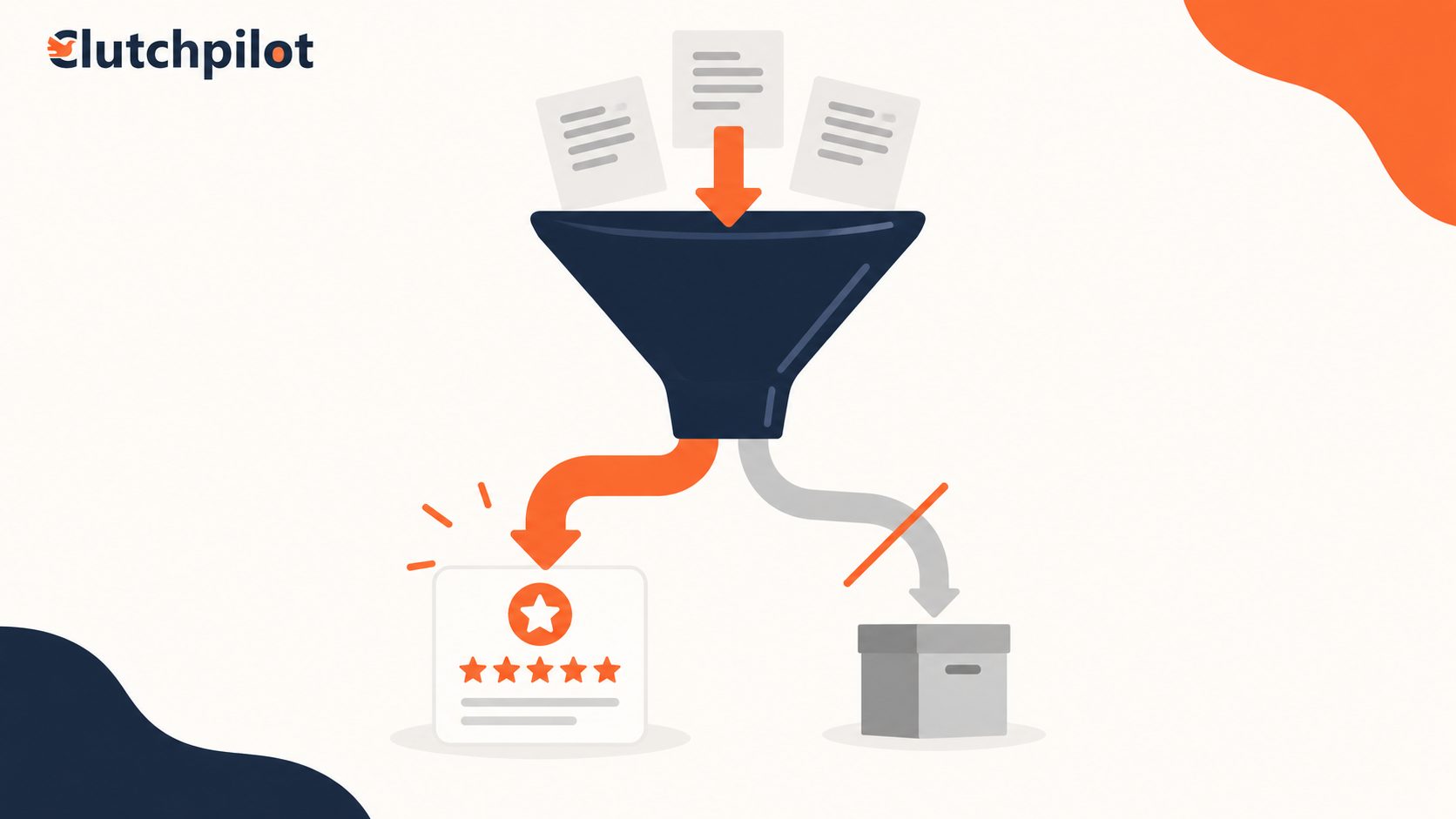
Review gating means surveying customers first, then sending the happy ones to a public review page and routing the unhappy ones to a private feedback form.
It is prohibited, and it is extremely widespread.
Worth being fair about why. A lot of businesses doing this are not trying to cheat. Several review platforms shipped gating as a product feature, marketed it as reputation management, and plenty of owners switched it on assuming that a vendor would not sell something against the rules. The practice spread on the back of that assumption.
The rule is simply that everyone gets asked the same way. Same message, same timing, same link, regardless of how you think the job went.
That feels riskier than it is. A profile with a realistic spread of ratings reads as genuine, and a handful of mixed reviews with good responses underneath them does more for a cautious customer than an unbroken wall of five stars. The answer to unhappy customers is handling the complaint well in public, not diverting it somewhere quieter.
What actually works
Ask after they have left, on their own device
Timing is the single biggest lever, and it is also a compliance boundary.
Asking while the customer is standing at your counter is pressure, whether you intend it that way or not, and requiring or pressuring someone to review on the premises is prohibited. A request that arrives an hour or a day later, on their own phone, is both compliant and more likely to get a considered response.
There is a second, separate reason to avoid the shared tablet by the till. Reviews submitted from one device on one IP address cluster together, and that clustering trips spam detection regardless of whether the reviews are genuine. You can do everything honestly and still have the batch flagged.
Ask everyone, the same way
The compliance reason is that selective solicitation is banned.
The practical reason is that it produces a better profile. Businesses that ask everyone end up with a mix, and a mix is what credibility looks like. Customers are more suspicious of perfect scores than of a 4.5 with a couple of complaints handled politely underneath.
Make it one tap
Every additional step between the request and the submitted review costs you completions.
QR codes on receipts, invoices and take-home cards are explicitly permitted, as are review links in follow-up messages. Use the direct link to your review form rather than sending people to a homepage to find it themselves. Someone willing to spend thirty seconds on you will not spend three minutes.
Automate the timing, not the content
Triggering a request when a job completes is sensible and permitted. It makes the asking systematic rather than dependent on whether anyone remembered.
What you cannot automate is what the customer says. Templates that suggest phrases, prompt for particular details, or ask the customer to mention a person or a service by name now fall under the content-direction prohibition added in April.
The line is clean: you can control when the request goes out and what it looks like. You cannot control what goes in the review.
Let staff ask, without setting targets
A person asking a person still works better than any automated message, particularly in trades and services where there is a real conversation at the end of the job.
What changed is the management layer around it. Staff quotas are now prohibited, as is tying reviews to performance metrics or running team contests on review counts.
The distinction is between building a habit and setting a target. "Mention it if the customer seems happy" is fine. "Everyone needs five this month" is a policy violation, and it also produces exactly the review patterns that automated detection looks for.
Respond to every review
Google encourages responses, and they do something no request can.
A customer deciding whether to bother writing something can see whether previous reviews were read. A profile where every review has a considered reply signals that feedback goes somewhere. A profile with sixty reviews and no responses signals the opposite.
What not to do
Buying reviews. Illegal under the FTC rule and banned by every platform. Also increasingly easy to detect, since bought reviews arrive in patterns.
Offering any incentive on Google. Including discounts, free products, loyalty points and giveaway entries. The FTC would permit some of these with disclosure. Google does not permit any of them.
Gating. Prohibited, common, and often switched on without anyone realising it is a problem.
Asking for specific content. Including asking customers to name the person who served them. New as of April 2026 and still widely recommended elsewhere.
Review kiosks and tablets on the premises. On-premises pressure is prohibited, and shared-device clustering causes problems independently.
Staff quotas and contests. Also new in April, and the resulting review patterns are conspicuous.
What a realistic timeline looks like

Every page on this subject promises to multiply your reviews in ninety days. Here is the less exciting version.
Only a small fraction of satisfied customers write reviews unprompted, and asking properly lifts that fraction rather than transforming it. Your realistic ceiling is a proportion of your transaction volume, which means a business serving thirty customers a month and one serving three hundred are in completely different situations regardless of technique.
Steady accumulation beats a burst, and not only for appearances. A profile that gains three or four reviews a month for a year looks like a functioning business. The same number arriving in one fortnight looks like a campaign, and with moderation now running before publication, that pattern is exactly what gets examined.
Set the expectation in months rather than weeks, ask consistently, and treat the count as a byproduct of asking everyone rather than as the target.
The short version
Ask everyone, the same way, with no exceptions for the ones you think will be unhappy.
Ask after they have left, on their own device, with a link that takes one tap.
Never script what the review should say, and never set your staff a number.
That is the whole method, and it is slower than the alternatives for the straightforward reason that it is the only one that survives contact with a moderation system. If you are still deciding which platforms to be on, our guide to review sites by sector covers where it is worth putting the effort, and you can see how established profiles look in the business services category.
Comments (0)