


This article is general information, not legal advice. Dollar limits, licensing rules and court procedures vary by state, and for a significant amount you should speak to a lawyer or your state consumer protection office.
Most complaints fail for the same reason. They are a feeling rather than a document.
A complaint that works has four parts. What happened, with dates. What you want, as a specific number or action. A deadline. And a stated consequence when the deadline passes.
Miss any one of those and the complaint goes to the bottom of somebody's pile, where it stays. Include all four and it moves out of customer service and into the hands of a person who is accountable for it.
This article gives you the letter, then the ladder to climb when the letter does not work, with real timings at every rung.
The letter resolves more cases than people expect. That is worth knowing before you spend a week on hold.
The escalation ladder
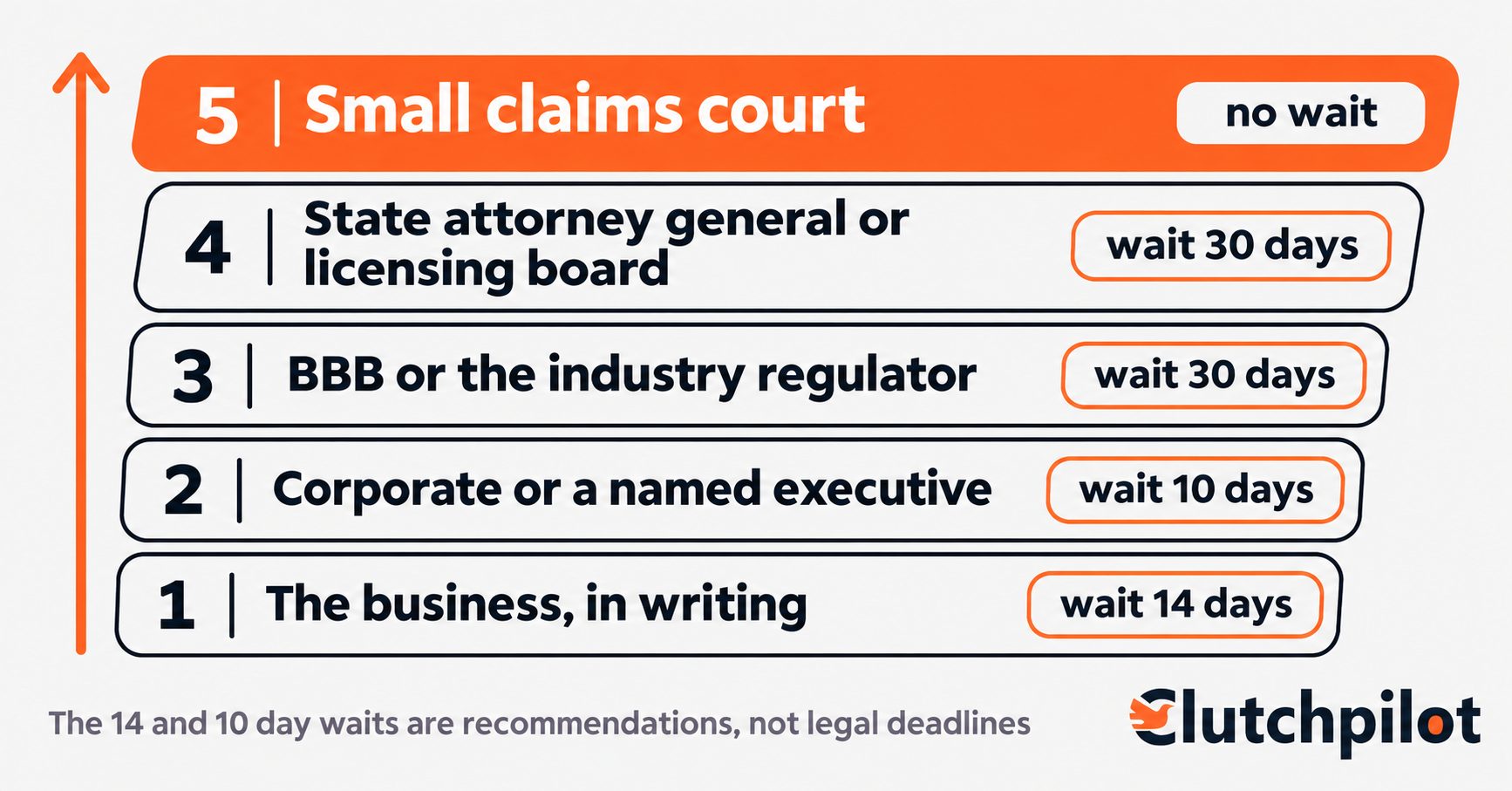
| Rung | Who you contact | Wait before escalating |
|---|---|---|
| 1 | The business, in writing | 14 days |
| 2 | Corporate, or a named executive | 10 days |
| 3 | BBB, or the industry regulator | 30 days |
| 4 | State attorney general, licensing board | 30 days |
| 5 | Small claims court | n/a |
One thing to be clear about, because other guides are not. The 14 day and 10 day waits are practical recommendations, not legal deadlines. Nothing requires a business to reply to you in two weeks. They work because a named deadline creates a decision point, and because an expired deadline is useful evidence at the rungs above.
Where a real legal deadline does exist, which is the credit card route, it is set out separately below with its source.
Rung 1. The business, in writing
You have probably already phoned. If the person you reached will not give you the resolution you want, ask for a manager or a supervisor once. Then stop talking and start writing.
Why written matters more than people think. A phone call creates no record, usually reaches somebody with no authority to say yes, and is forgotten by the next shift. A letter creates a dated document, and every rung above this one will ask you for exactly that.
Before you write, gather:
- The product or service name, with any serial or model number
- The date and place of purchase
- Your account, order or invoice number
- What you were promised, and what you actually received
- Copies of receipts, contracts, emails and texts
Send copies and keep the originals. This is the FTC's own instruction and it is the mistake people make exactly once. Original receipts and signed contracts do not come back.
The template letter
Copy this, fill in the brackets, and delete anything that does not apply. It is deliberately plain. A letter that reads like a document gets treated like one.
[Your full name] [Your street address] [City, State ZIP] [Your phone number] [Your email address]
[Date]
[Name of a specific person, if you have one] [Their job title] [Company name] [Company street address] [City, State ZIP]
Re: [Account / order / invoice number], request for [refund / replacement / repair]
Dear [Name, or "Sir or Madam"],
On [date], I purchased [product or service, including model or serial number] from [location, website, or branch] for [amount]. My [account / order] number is [number].
[Describe what went wrong, factually and in order. Give dates. For example: "The unit stopped working on 14 October 2026, eleven days after delivery. On 16 October I was told a replacement would ship within five business days. As of today, no replacement has arrived and no further explanation has been given."]
I have already attempted to resolve this. On [date] I [called / emailed / visited] and spoke with [name or description of person], who told me [what they said]. On [date] I followed up and [what happened]. The problem remains unresolved.
To resolve this, I am requesting [a refund of $X / replacement of the item / repair at no cost / cancellation of the contract and a refund of $X].
Please respond in writing by [date, 14 days from the date of this letter]. If I have not received a response by that date, I will file complaints with the Better Business Bureau and with the [State] Attorney General's consumer protection division, and I will consider further action available to me.
Copies of the following are enclosed. I have retained the originals.
- [Receipt dated X]
- [Contract or order confirmation]
- [Email correspondence dated X to Y]
- [Photographs of the item]
I can be reached at [phone] or [email].
Sincerely,
[Signature] [Your printed name]
Why each part is there
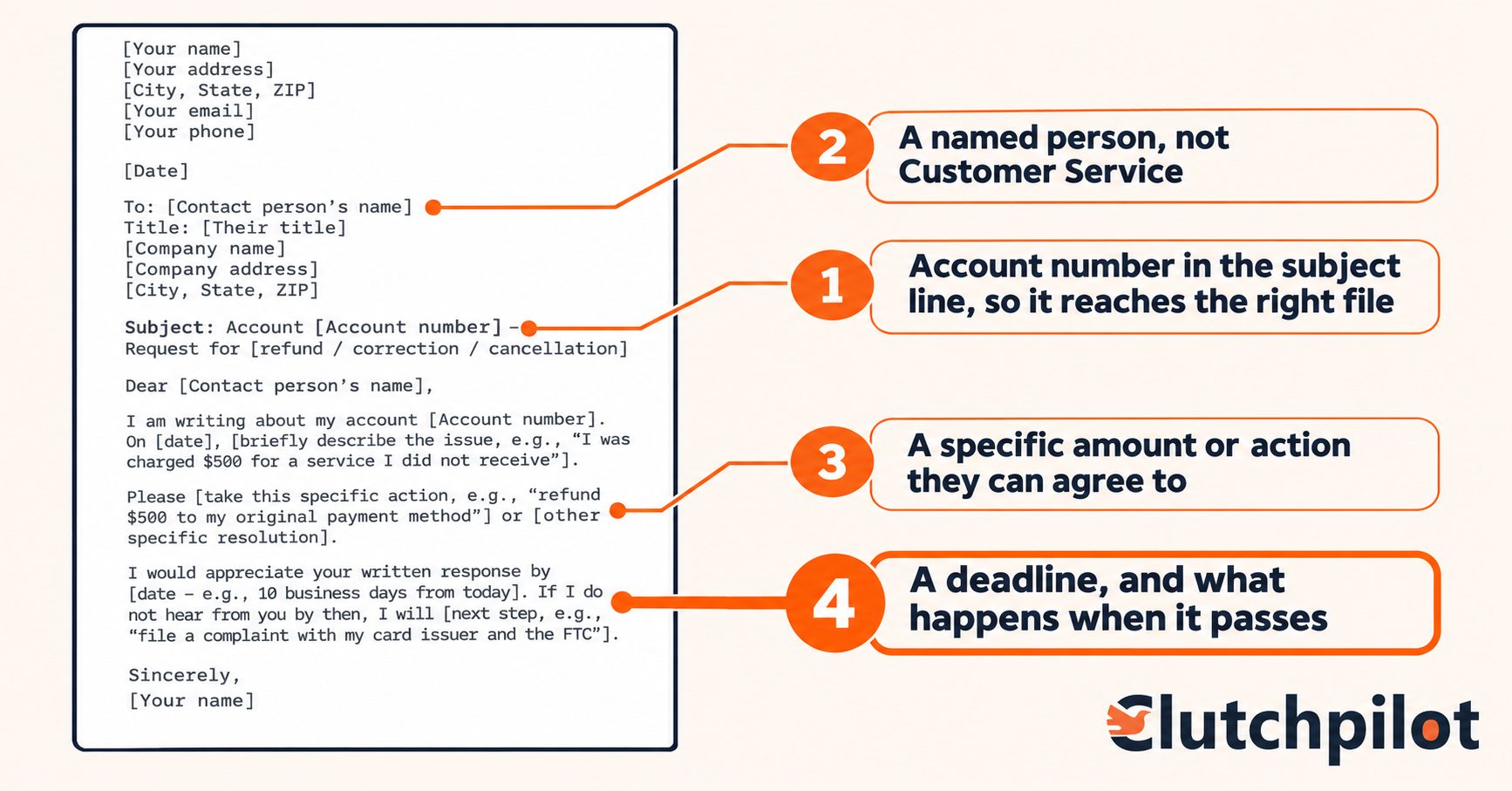
The subject line carries your account number. It gets the letter to the right file instead of the wrong department.
A named recipient beats "Customer Service." A letter addressed to a person is a letter somebody owns. Company websites, LinkedIn and your state's business registry will usually get you a name.
Paragraph four is where most complaints fail. "I want this sorted out" is not something a business can agree to. "I am requesting a refund of $412.80" is. Name the number, or name the action.
Paragraph five is the one people leave out, and it is the one that works. The FTC's own guidance on what a complaint letter should contain is to say how long you will wait and to say that you will report the matter to your state attorney general or consumer protection office if you do not hear back. That sentence changes who reads your letter, because it converts an annoyed customer into a compliance problem.
Keep the tone flat. No anger, no insults, no account of how this has made you feel. Everything factual in your letter is weakened by one sentence of outrage, and that sentence gives the recipient a reason to file you as difficult rather than correct.
How to send it
Certified mail, return receipt requested. The FTC recommends it and the reason is simple: it proves the business received your letter, and on what date. Every rung above this one may ask you to show that.
Keep a copy of the letter itself, not just the enclosures. People remember to copy the receipt and forget to copy the letter.
Email it as well if you have an address. Post is the record, email is the speed. Send the same text and note in the email that a signed copy has been posted.
Write the send date on your own copy and put the deadline in your calendar the same day. The ladder only works if you actually climb it.
Certified mail with return receipt costs a few dollars. It is the cheapest evidence you will ever buy.
If your complaint is about a charge on your card
This is a different route, with real legal deadlines and a trap in it.
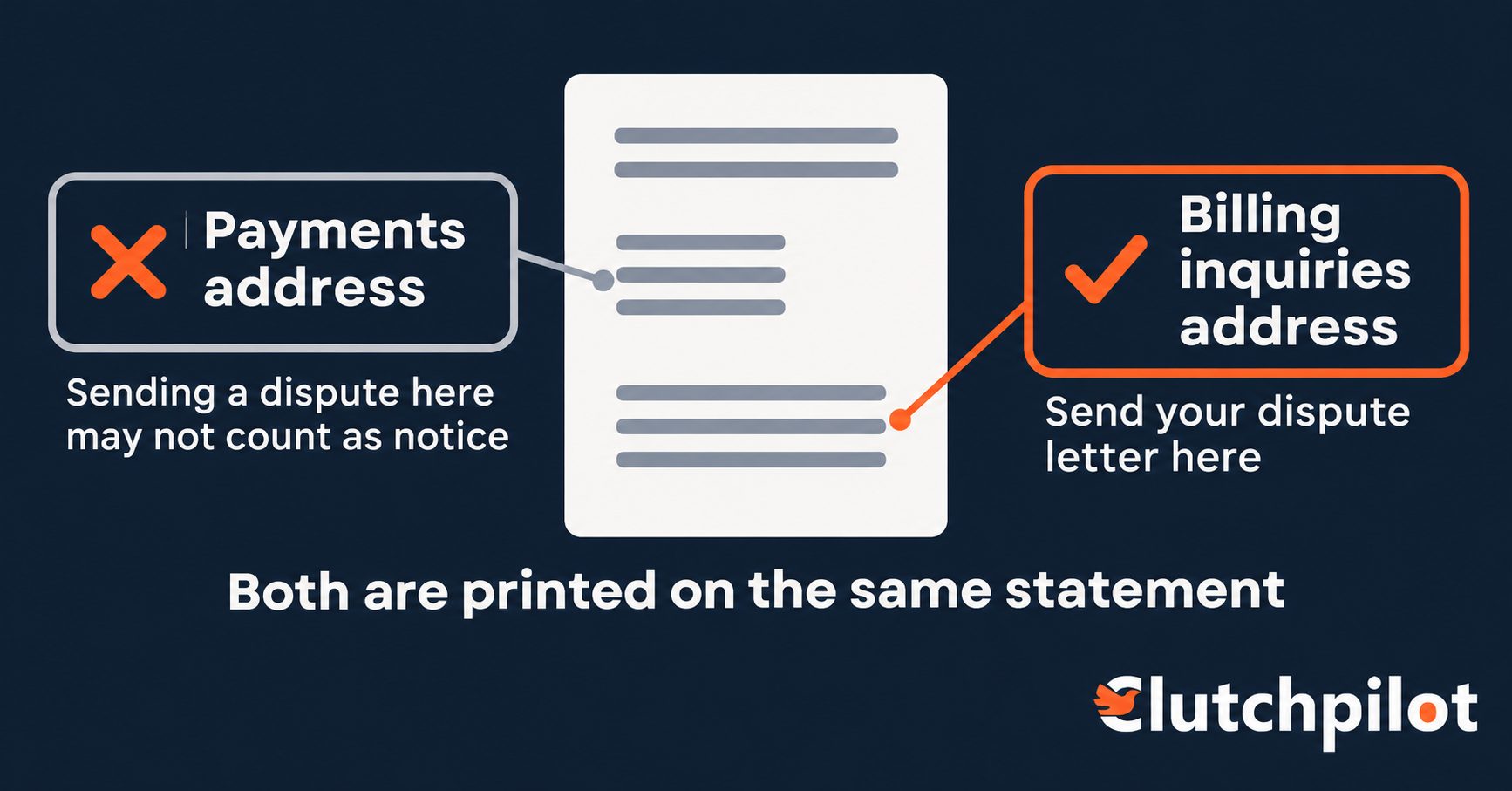
The trap first. The FTC's instruction is to "use the address given for billing inquiries, not the address for sending your payments". Those are two different addresses printed on the same statement. A dispute letter sent to the payments address may not count as having given notice, which can cost you the protection entirely.
The deadlines, all three statutory:
- Your letter must reach the issuer within 60 days after the first bill showing the error was sent to you
- The issuer must acknowledge your complaint in writing within 30 days of receiving it
- The issuer must resolve the dispute within 90 days of receiving it
What the letter must include: your name, address, account number, and a description of the mistake. Copies of supporting documents, not originals. Keep a copy of the dispute letter.
Note that this is about writing and addressing the letter correctly. Running the dispute itself, what issuers actually accept and what tends to fail, is a bigger subject that we cover separately.
Rung 2. Go above customer service
Your deadline has passed and either nothing came back or what came back was useless.
Find a named person with authority. A regional manager, a head of customer experience, a general counsel at a mid-sized company, the owner at a small one. Company websites, LinkedIn and state business registries between them will usually produce a name and a mailing address.
Send the same letter with a short covering line: the date of your first letter, the fact that it went unanswered or was not resolved, and your original request restated unchanged.
Why this works more often than the first letter. The person receiving it can actually say yes, and an unanswered written complaint with a certified mail receipt attached now reflects on somebody specific.
Escalate once. Writing to eight people simultaneously reads as harassment rather than persistence, and it gives everyone involved permission to treat you as the problem.
Rung 3. The BBB, and what it will not take
Free, genuinely useful, and widely misunderstood in both directions.
The process, with BBB's own numbers. According to BBB's own description of its complaint process, your complaint is forwarded to the business within two business days. The business then has 10 to 15 calendar days to respond, with a follow-up if it does not. Complaints are generally closed within 30 days, carrying one of five statuses: Resolved, Answered, Unresolved, Unanswered, or Unpursuable.
And it becomes public. After a complaint closes, its text may be posted publicly with personal details removed, and it stays on the business profile for three years from the filing date.
That public record is the real leverage, not the mediation. A business weighing twenty minutes of effort against three years of visible "Unanswered" usually does the twenty minutes.
What BBB will not handle, which almost nobody tells you before you spend time on the form:
- Debt collection
- Complaints based only on price
- Buyer's remorse
- Employer and employee disputes
- Anonymous complaints
- Companies that are out of business
- Matters already resolved by court action, arbitration or settlement
- Complaints based solely on discrimination
- Complaints solely seeking criminal penalties
Read that list before you start. Several of the most common consumer complaints are on it.
One thing to be clear about: BBB is not a regulator. It is a private organisation. It cannot fine a business, suspend anything, or compel a response. What it can do is create a public record, and that is worth more than people assume.
Rung 4. The regulator and your state attorney general
This is where your complaint acquires enforcement behind it.
The industry regulator, which depends entirely on the kind of business. Financial products, movers, insurers, investment firms and licensed trades each have their own, and the right specific regulator is far more effective than a general complaint filed anywhere.
Your state attorney general. Every state runs a consumer protection division, and many will attempt mediation with the business directly, which is a service federal agencies do not provide. A federal agency handles patterns. A state attorney general will sometimes handle you.
The licensing board, if the business holds a licence. For a contractor, a mover, an electrician or a care provider, this is frequently the strongest lever a single customer has, because the business has something concrete to lose. Check whether the licence is bonded as well, since a surety bond can be an actual route to compensation.
Working out which agency covers your situation is a directory of its own rather than a paragraph. Our guide to confirming a business is real covers the registry and licence checks you will need before you file.
Rung 5. Small claims court
Less intimidating than most people assume, which is why it belongs on this list rather than in a separate conversation about lawyers.
What it is for. A specific sum of money, documented, below your state's small claims limit. Those limits vary widely between states, so look yours up rather than relying on a figure you read somewhere.
What it costs. A filing fee, usually modest, and sometimes recoverable if you win. You do not need a lawyer, and in many states lawyers are not permitted in small claims at all.
What you need. Precisely what the four rungs below produced: the letter, the certified mail receipt proving it arrived, the dated record of what was promised and by whom, and evidence of what you actually lost.
And this is the point of the whole article. A judge is persuaded by a dated written demand that went unanswered. That document gets created in your first week, not your last. People who skip rung 1 and arrive here with a grievance and no paperwork are the people who lose.
Check two things before filing: whether your contract contains an arbitration clause, which may route you elsewhere, and how long you have, because claims expire.
Five mistakes that sink a complaint
No specific request. The most common failure by a wide margin. If the business cannot literally agree to what you wrote, you have not made a request.
No deadline. An open-ended complaint has no decision point, so nobody ever has to make a decision.
Sending originals. Copies only, every time. Originals do not come back and you will need them later.
Writing while angry. Write it, then send it the next morning. The version you would have sent last night was worse.
Skipping rungs. Filing with the attorney general before you have written to the business means the first question you get asked is whether you contacted the business in writing. Build the record in order.
Start here
Write the letter today, while you still remember the dates.
Name a number. Set a 14 day deadline. Say what you will do when it passes. Send it certified mail, return receipt requested, and keep a copy.
Then put the deadline in your calendar, and climb when it arrives.
Comments (0)