



This is general information, not financial or legal advice. Federal rules set a floor and your card agreement, your issuer's own policies and your state's law may all give you more. Deadlines and conditions are strict and they vary by route, so for a significant amount check with your issuer or a lawyer rather than relying on this page.
Almost every guide to this subject is published by a card issuer, and an issuer's guide describes an issuer's form. It will not tell you which disputes fail, that a dispute can be reversed weeks after you get the money, or that the merchant gets a formal right to answer you.
Short answer: disputes are won on routing, timing and evidence, not on being right. Three things decide the outcome. Which of the three separate processes you use. Whether you are inside the window for that specific process. And whether you documented your attempt to sort it out with the seller before you filed.
There is also a second statutory route with a window of up to a year, under specific conditions, which almost no guide mentions. It is covered below, with the conditions, because they matter as much as the deadline.
Three different things people call "disputing a charge"
Using the wrong one is the most common avoidable failure in this whole subject. These are not interchangeable.
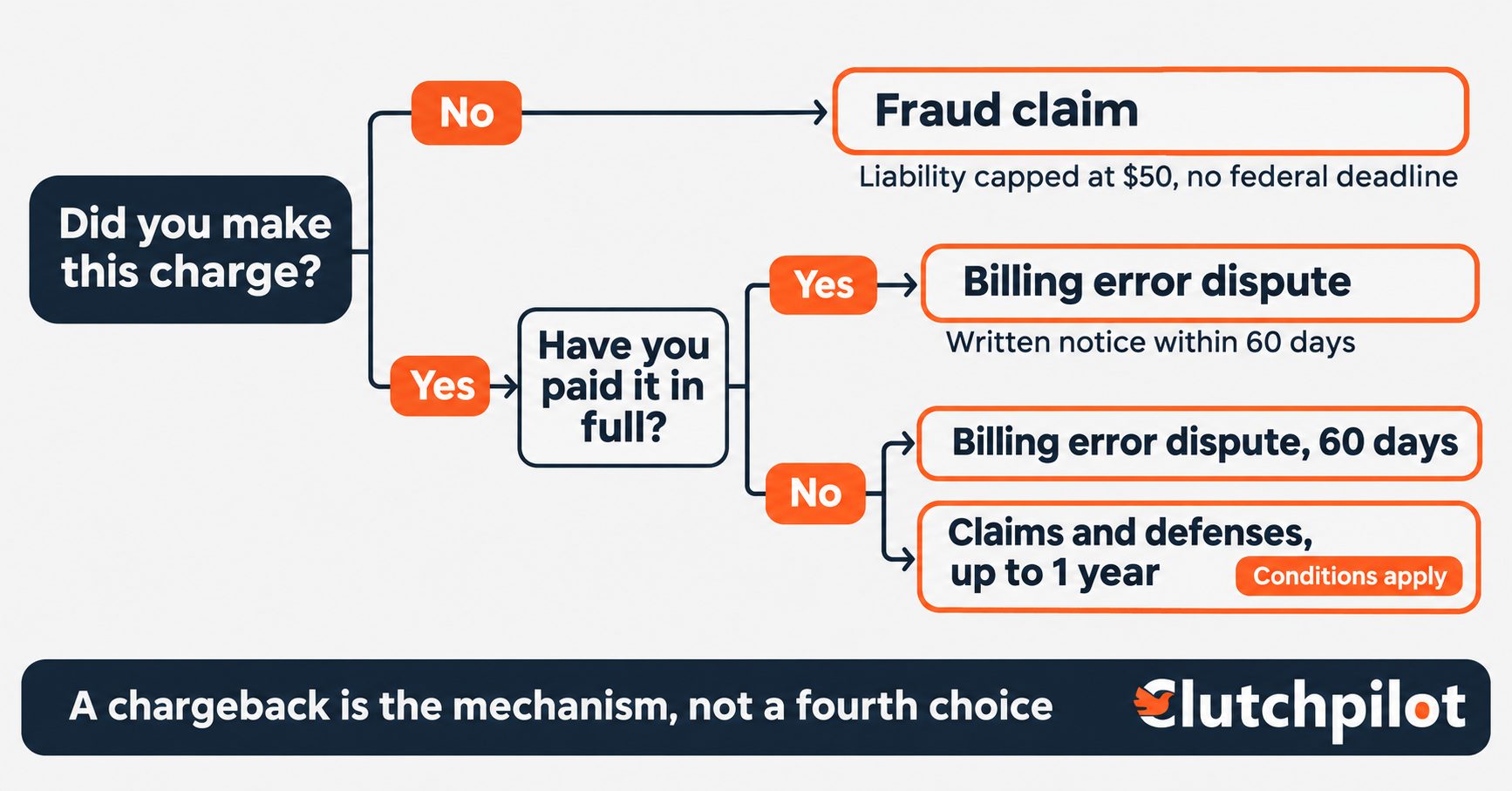
A fraud claim
You did not make the charge. Somebody used your card, or your card number, without permission.
Federal law caps your liability at $50 and most issuers apply a zero liability policy on top of that. There is no federal deadline on reporting an unauthorised charge, though reporting quickly still matters for other reasons.
A billing error dispute
You did make the charge, or a charge exists that should not. The amount is wrong. You were billed twice. The goods never arrived. The service was never provided. You cancelled and were billed anyway.
This is the Fair Credit Billing Act route. It runs on written notice and it has deadlines.
A chargeback
The card network mechanism that actually moves money back out of the merchant's account.
Your issuer initiates it against the merchant's bank under network rules, with its own windows and its own evidence standards. The FCBA gives you the right to dispute. The chargeback is the plumbing that carries out the result.
Why the distinction decides outcomes
Filing a fraud claim for a purchase you actually made is the fastest route to a closed account. It triggers a different investigation, the merchant usually holds authorisation records that prove you made the purchase, and a pattern of fraud claims that do not hold up gets noticed.
The reverse mistake costs you time. Filing a careful billing error dispute for genuine card theft means assembling documents you did not need and slowing down a claim that would have been resolved faster.
Decide which of the three you are actually filing before you touch a form.
The time limits
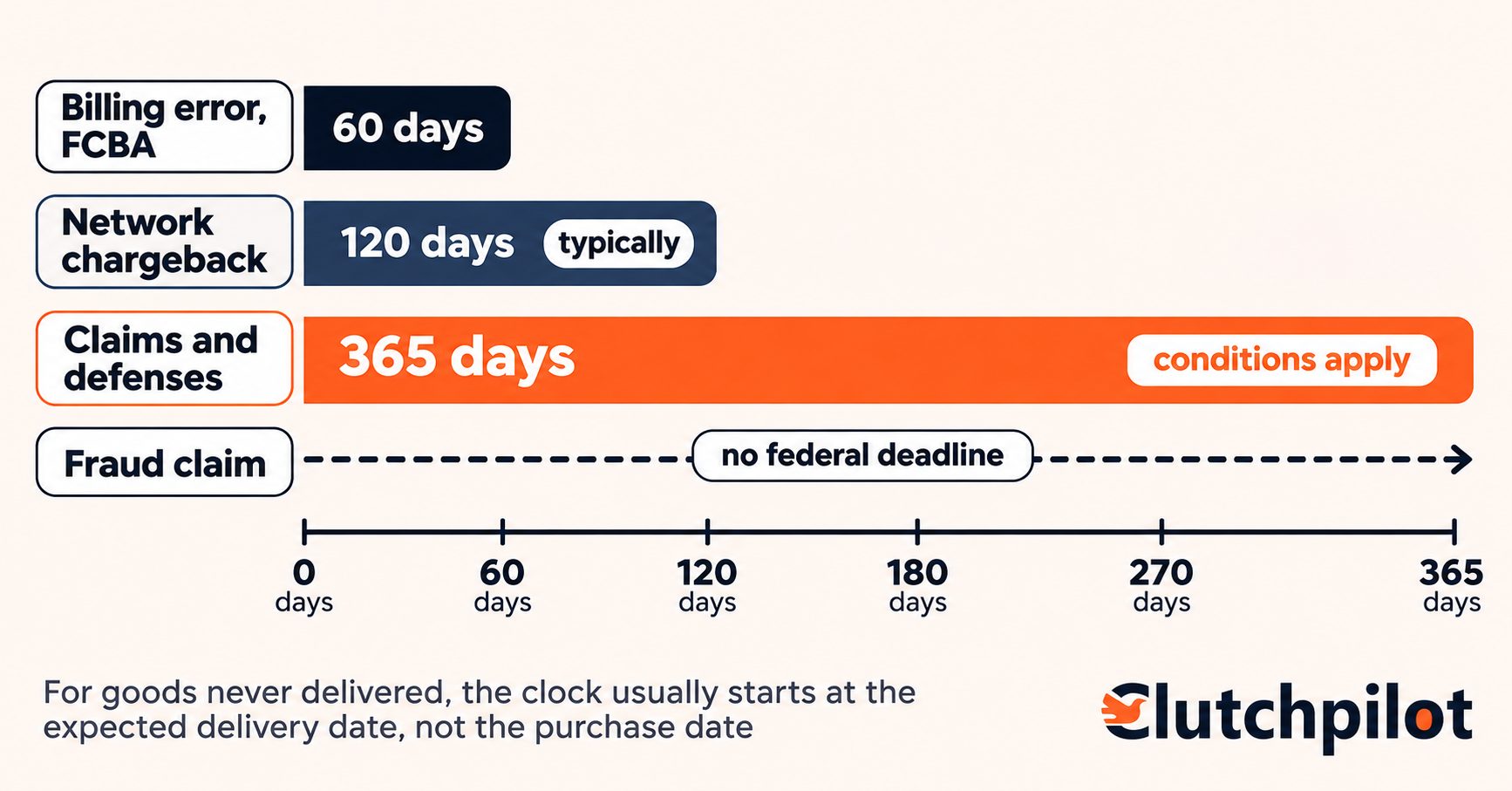
| Route | Deadline | Clock runs from |
|---|---|---|
| Fraud, unauthorised charge | No federal deadline | n/a |
| Billing error, FCBA | 60 days | Issuance date of the first bill showing the charge |
| Claims and defenses, FCBA | Up to one year | First bill showing the charge |
| Network chargeback, Visa and Mastercard | Typically 120 days | Processing date, or expected delivery date for goods not received |
| Amex and Discover | Up to 120 days | Transaction or processing date, with later starts for non-delivery |
The 60 day route
Send written notice to the address for billing inquiries so that it reaches the issuer within 60 days after the first bill showing the error was sent to you. The issuer then has 30 days to acknowledge your dispute in writing and 90 days to resolve it.
Note what the clock runs from. Not the purchase date, and not the day you noticed. The issuance date of the first statement that showed the charge.
The one-year route almost nobody mentions
There is a second route under the same federal law, which California's Attorney General sets out alongside the first. It is called the claims and defenses route, and the window runs up to one year after the first bill showing the charge.
It is not a general extension, and the conditions are not optional. All of these have to hold:
- The disputed amount is more than $50
- You made a good-faith effort to resolve the problem with the seller first
- You have not paid the charge in full. If you have paid part of it, you can dispute only the remaining balance, and amounts you have already paid are not recoverable this way
- The seller is in your state, or within 100 miles of your billing address. This condition may not apply to purchases made online or by phone
Read that third condition twice, because it is the one that catches people. Paying the disputed amount to keep your account tidy can remove this route entirely.
So the honest version is this. If you are at day 90 with an unpaid charge over $50 and a documented attempt to resolve it with the seller, you are not necessarily out of time, which is what every other article on this subject would tell you. Check the two separate dispute routes under federal law against your own facts before you give up.
The non-delivery clock is the generous one
For goods that never arrived, the network window generally runs from the expected delivery date rather than the transaction date. For a pre-order, a custom build or anything with a long lead time, that can be months of additional room that a purchase-date calculation would have hidden.
How to file, step by step
1. Contact the merchant first, and record it. Date, who you spoke to, what was said, what they offered. This is a condition of the one-year route and in practice both issuers and networks expect to see it.
2. Gather your evidence before you file. Checklist below. Filing first and scrambling afterwards is how people lose on a technicality.
3. File with the issuer. Phone or app is fastest and starts things moving.
4. Follow up in writing to the billing inquiries address if you are relying on FCBA protection. The FTC's rules on written notice and issuer deadlines are specific about this, and a phone call alone does not preserve the statutory right.
5. Pay the rest of your bill on time. You may withhold the disputed amount. While the investigation runs, the issuer cannot treat your account as late or report you delinquent on that amount, though it may report the amount itself as disputed.
6. If the issuer rules against you, you have 10 days to respond with more evidence, and you can ask for the documents it relied on to reach that decision.
That last step is almost never mentioned anywhere, and it is often the difference between a dispute that ended badly and a dispute that got a second look. Ask for the documents. Then answer them.
The letter, and where it goes
One detail matters more than anything else about the letter. It goes to the address for billing inquiries, not the address for payments. Those are two different addresses printed on the same statement, and a dispute sent to the payments address may not count as having given notice at all.
Send it certified or with tracking, keep a copy of the letter itself rather than only the enclosures, and write the send date on your copy.
If you want a letter structure to adapt, our guide to confirming a business is real and the complaint process around it covers the written approach in more detail.
The evidence checklist
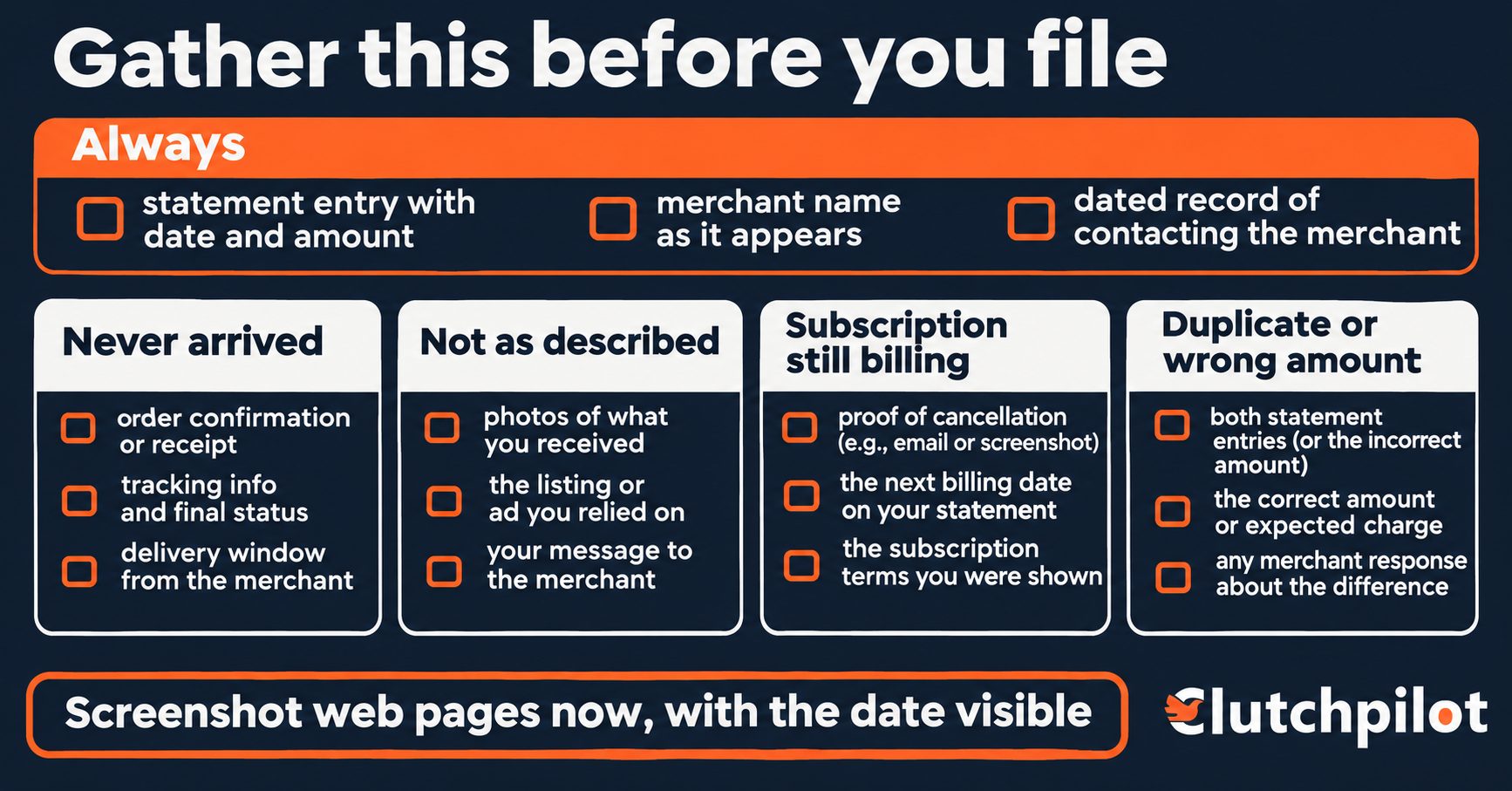
What wins differs by dispute type. Gather the items for your situation, plus the three that always apply.
Always:
- The statement entry showing the charge, with date and amount
- The merchant name exactly as it appears on the statement, plus the trading name if it differs
- Your dated record of contacting the merchant, and their response or silence
Goods never arrived:
- Order confirmation showing the promised or expected delivery date
- Tracking showing non-delivery, or evidence that no tracking was ever provided
- Your message asking where the order is, with the date
Goods not as described:
- The listing or advert as it appeared when you bought, screenshotted
- Photographs of what actually arrived
- Any return instruction you were given, and proof you followed it
Cancelled subscription still billing:
- The cancellation confirmation, or your dated attempt to cancel
- The terms as they appeared when you signed up
- Every charge taken after the cancellation
Duplicate charge or wrong amount:
- Both charges side by side, or the receipt showing the agreed amount
- The original quote or invoice
One rule above all of these. Screenshot web pages now, with the date visible, before anything changes. Listings get edited, terms get updated, and cancellation pages get redesigned. The evidence that most often disappears is the evidence that was easiest to capture on day one.
The merchant gets to answer, and often wins
Here is what the issuer guides leave out, and it changes how you should approach the whole thing.
A chargeback is not a decision. It is the opening move.
The merchant's bank receives the chargeback and the merchant can contest it through a process called representment, submitting a rebuttal letter and what the industry calls compelling evidence. The network windows and the merchant's representment deadlines are tight and specific:
- Visa: 30 days for the merchant to submit representment. If the issuer escalates, 30 days to begin pre-arbitration, 30 days for the merchant to respond, then 10 days for the issuer to pursue arbitration
- Mastercard: 45 days to initiate representment, then 8 days to submit the documentation
- Amex: 20 days to respond, with no arbitration process
- Discover: 30 calendar days, with arbitration generally initiated within 10
What this means for you in practice: a provisional credit is not a win. The money can appear in your account and then leave it again. Large merchants treat disputes as a routine cost of business and some have dedicated teams and software for exactly this.
And this is the real reason to contact the merchant before filing. Compelling evidence frequently includes the merchant's own record of your contact with them. A merchant who can show they offered you a refund you never collected, or that you never got in touch at all, has a strong representment. A merchant who ignored three dated emails has very little to submit.
You are not arguing with your bank. You are assembling a file that will be read alongside the merchant's file.
One note on these network figures. They come from industry guidance rather than from a regulator, because card network rulebooks are not public consumer documents and no government source publishes merchant-side operational deadlines. Treat them as typical rather than universal, since they vary by dispute reason and the networks revise them.
What does not work
The part no issuer will ever publish.
1. Buyer's remorse. You received exactly what you ordered and changed your mind. That is a returns conversation. The dispute process is not a returns policy and using it as one fails.
2. Calling it fraud when you made the purchase. Different investigation, worse consequences, and the merchant usually holds records showing you authorised it. Repeated fraud claims that do not stand up are how accounts get closed.
3. A price you later found cheaper somewhere else. Not a billing error, not a dispute, not anything.
4. A subscription you forgot about but did genuinely authorise. Cancel it, then ask the merchant for a refund on the unused period. A dispute on charges you agreed to usually fails, and it is one of the easiest things in the world for a merchant to win on representment, because they have your sign-up record.
5. Disputing instead of cancelling. A dispute reverses one charge. It does not cancel anything, so the next charge arrives on schedule and you start again.
6. Filing on the one-year route after paying the charge in full. Amounts already paid are not recoverable by that route. Partial payment limits you to the remaining balance.
7. Verbal notice only, when you need FCBA protection. The phone call starts the practical process. The statutory right attaches to written notice.
8. Concluding you are out of time without checking. Before you accept that the 60 days has passed, check the one-year route against your facts and check whether the non-delivery clock gives you a later start.
And the honest framing to finish on. Issuers are measurably less generous with people who dispute often, and with large amounts. The dispute system works, and it is not unlimited. Using it for things it was never built for makes it less available on the day something genuinely goes wrong.
What it does to your credit
Filing a dispute does not damage your credit by itself.
While an investigation is running, the issuer cannot report the disputed amount as late or treat you as delinquent on it. It may mark the amount as disputed, which is a notation rather than a negative mark.
What does cause real damage is the mistake people make while waiting. You may withhold the disputed amount. You may not withhold the rest of the bill. People hold back the entire balance on principle, win the dispute two months later, and collect a genuine late payment on everything else in the meantime.
Separately, there is the account closure risk. That is not a credit scoring mechanism, and an issuer deciding it no longer wants your business is a real consequence of a pattern of disputes rather than of any single one.
The three that decide it
Pick the right route. Fraud, billing error, or claims and defenses. They have different rules and the wrong choice can cost you the case before it starts.
File inside the right window, which may be considerably longer than the 60 days everyone quotes.
Document your contact with the merchant before you file. It is a condition of one route, an expectation on the others, and the single thing most likely to decide a contested dispute.
Comments (0)